Health check metrics is a panel in the article editor that surfaces SEO and readability issues before you publish. It gives you a real-time assessment of your article across nine parameters, classified into three levels: Problems, Suggestions, and Good Work, so you know exactly what needs attention and what is already optimised.
This feature is available for articles and category pages in English only.
When to use health check metrics
- Run it as part of your publishing checklist before every article goes live.
- Use it when auditing existing articles to identify SEO gaps such as missing meta titles or descriptions.
- Use it to improve content quality on high-traffic articles where readability directly affects reader engagement.
Access health check metrics
- Open the article in the knowledge base portal.
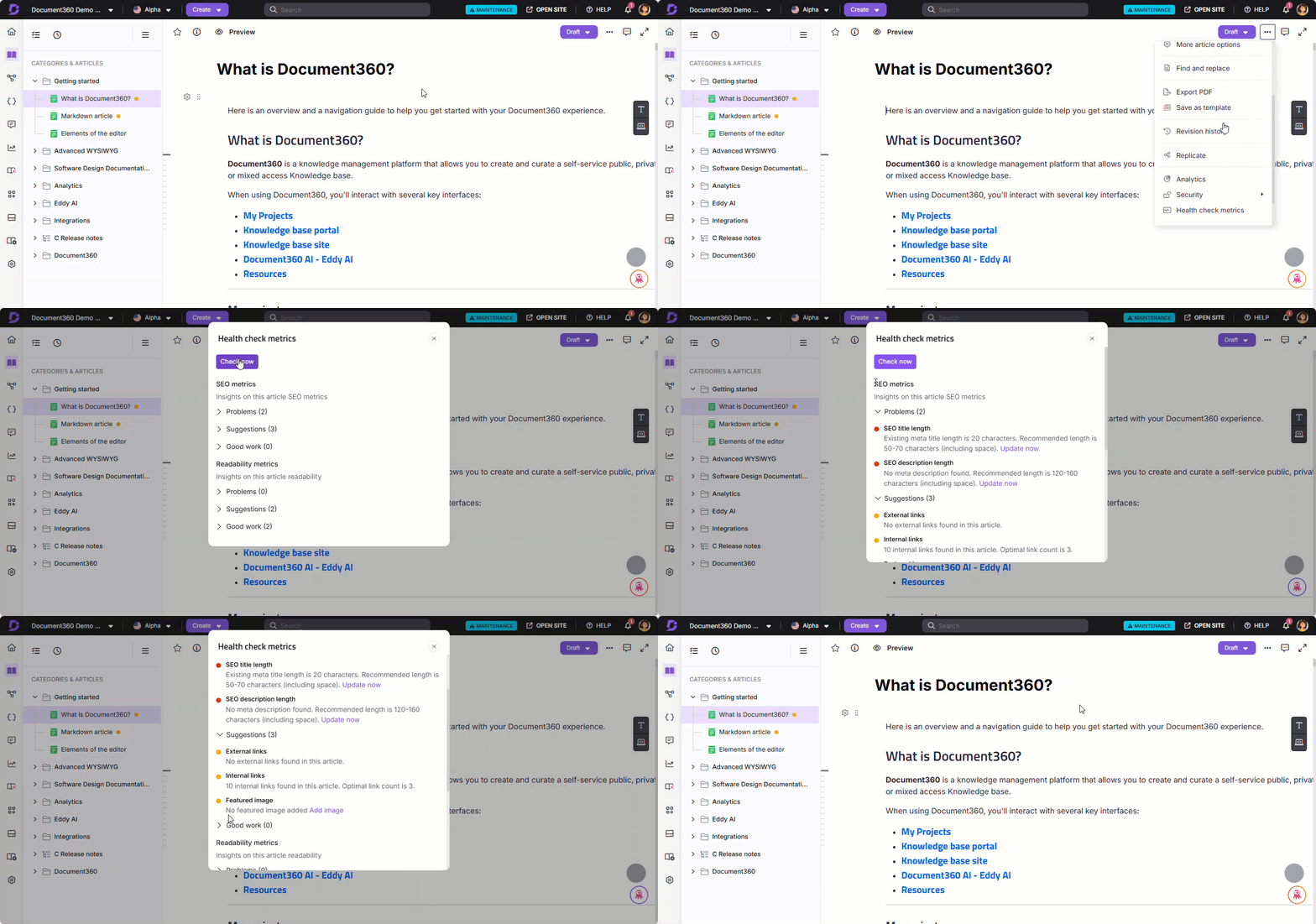
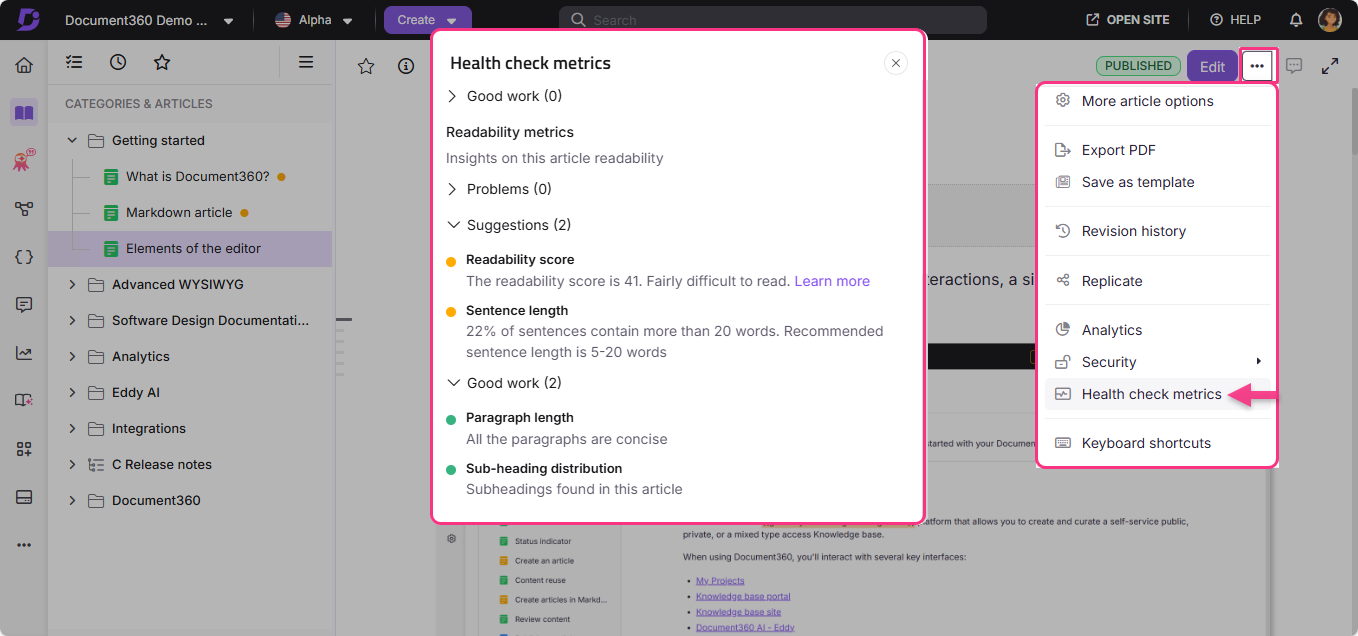
- Click the More () icon in the article header and select Health check metrics. The Health check metrics panel appears with two sections: SEO metrics and Readability metrics.
If you update any parameter while the panel is open, click Check now to refresh the results based on the latest changes.
What health check metrics covers
SEO metrics
Assess your article's SEO title length, AI & search description length, internal and external link count, and featured image presence.
View metrics →Readability metrics
Assess your article's readability score, paragraph length, sentence length, and sub-heading distribution.
View metrics →Metrics classification
Every metric in the panel falls into one of three categories:
| Classification | What it means |
|---|---|
| Problems | Requires immediate action before publishing. |
| Suggestions | Improvements that would strengthen the article. |
| Good Work | The metric is at an optimal level. |
SEO metrics
SEO title length
The SEO title appears in search engine results and browser tabs. The ideal length is between 50 and 70 characters.
| Character count | Classification |
|---|---|
| Less than 30 or more than 90 | Problems |
| 30 to 49 or 71 to 90 | Suggestions |
| 50 to 70 | Good Work |
Click Update now in the panel to navigate directly to the SEO title field.
AI & search description length
The AI & search description is the short summary shown in search results and used by AI agents to retrieve and cite the article. The ideal length is between 120 and 160 characters.
| Character count | Classification |
|---|---|
| Less than 80 or more than 160 | Problems |
| 80 to 119 | Suggestions |
| 120 to 160 | Good Work |
External links
External links point to URLs outside your Document360 project.
| Count | Classification |
|---|---|
| 0 or more than 3 | Suggestions |
| 1 to 3 | Good Work |
Internal links
Internal links include article links and category page links within your project. Media file links are not counted as internal links.
| Count | Classification |
|---|---|
| 0 or more than 3 | Suggestions |
| 1 to 3 | Good Work |
Featured image
A featured image appears alongside the SEO title and description when the article is shared on social media.
| Status | Classification |
|---|---|
| No featured image | Suggestions |
| Featured image present | Good Work |
Readability metrics
Readability metrics assess how easy your article is to read and understand. These metrics do not account for LaTeX expressions or code blocks.
Readability score
The readability score is calculated using the Flesch Reading Ease formula. It ranges from 0 to 100, where a higher score means more readable content.
| Score | Reading level | Classification |
|---|---|---|
| 90 to 100 | Very easy to read | Good Work |
| 80 to 89 | Easy to read | Good Work |
| 70 to 79 | Fairly easy to read | Good Work |
| 60 to 69 | Easily understood | Good Work |
| 30 to 59 | Fairly difficult to read | Suggestions |
| 0 to 29 | Hard to read | Problems |
Paragraph length
Long paragraphs make content harder to follow. The optimal length is 150 words or fewer per paragraph.
Two or more sentences without a line break are counted as a single paragraph.
| Status | Classification |
|---|---|
| Any paragraph exceeds 150 words | Suggestions |
| All paragraphs are 150 words or fewer | Good Work |
Sentence length
Shorter sentences are easier to read. The recommended maximum is 20 words per sentence.
A sentence is defined as a group of words ending with a period (.). Ordered and unordered list items with no full stop are counted as a single sentence.
| Status | Classification |
|---|---|
| Any sentence exceeds 20 words | Suggestions |
| All sentences are 20 words or fewer | Good Work |
Sub-heading distribution
Sub-headings improve readability and help readers navigate between sections. Use H2, H3, and H4 heading tags in the editor to add sub-headings.
| Status | Classification |
|---|---|
| No sub-headings present | Suggestions |
| Sub-headings used | Good Work |
Best practices
- Resolve all Problems before publishing. Suggestions should be addressed where possible but are not blockers.
- Address SEO title and description issues first. These have the most direct impact on search visibility and AI retrieval accuracy.
- Use the Update now links in the panel to jump directly to the field that needs attention without closing the panel.
- Run health check metrics on existing high-traffic articles periodically, not just at the time of publishing.
FAQ
Is health check metrics available for all languages?
No. Health check metrics is available for articles and category pages in English only.
Why are my health check results not updating after I make changes?
If the Health check metrics panel is open when you make changes to the article, click Check now in the panel to refresh the results. The panel does not update automatically.
How is the readability score calculated?
The readability score is calculated using the Flesch Reading Ease formula. It analyses sentence length and word complexity to produce a score from 0 to 100. Higher scores indicate simpler, more readable content.
Do code blocks and LaTeX expressions affect the readability score?
No. Readability metrics do not account for LaTeX expressions or code blocks. These elements are excluded from the sentence and paragraph length calculations.
Does having more than three internal links count as a problem?
No. Having more than three internal links is classified as a Suggestion, not a Problem. The recommended range is one to three internal links per article. Media file links are not counted as internal links.