Article analytics in Document360 shows how an individual article is performing, based on reads, views, likes, dislikes, following, and link status. Unlike the project-level Analytics (), which gives an overview of your entire knowledge base, article analytics focuses on a single article at a time. Use these metrics to see which articles engage readers and which links need fixing, then prioritize content updates accordingly.
Why use article analytics
Use article analytics when you want to:
- Find articles with low reads or a high number of dislikes that may need revision.
- Catch broken or outdated links in an article before readers report them.
- See how many readers follow an article, to gauge ongoing interest in the topic.
- Decide which articles to prioritize during a content review or revamp.
Before you begin
- Access to article analytics depends on your content role. Admins, Owners, and Contributors with an Editor or Draft writer content role can access Analytics.
- An admin can restrict this by creating a custom content role without the Analytics permission.
- If you cannot access article analytics, contact your project administrator to check your role and permissions.
Access the analytics panel
- In the editor, click More () in the article header.
- Select Analytics from the dropdown menu.
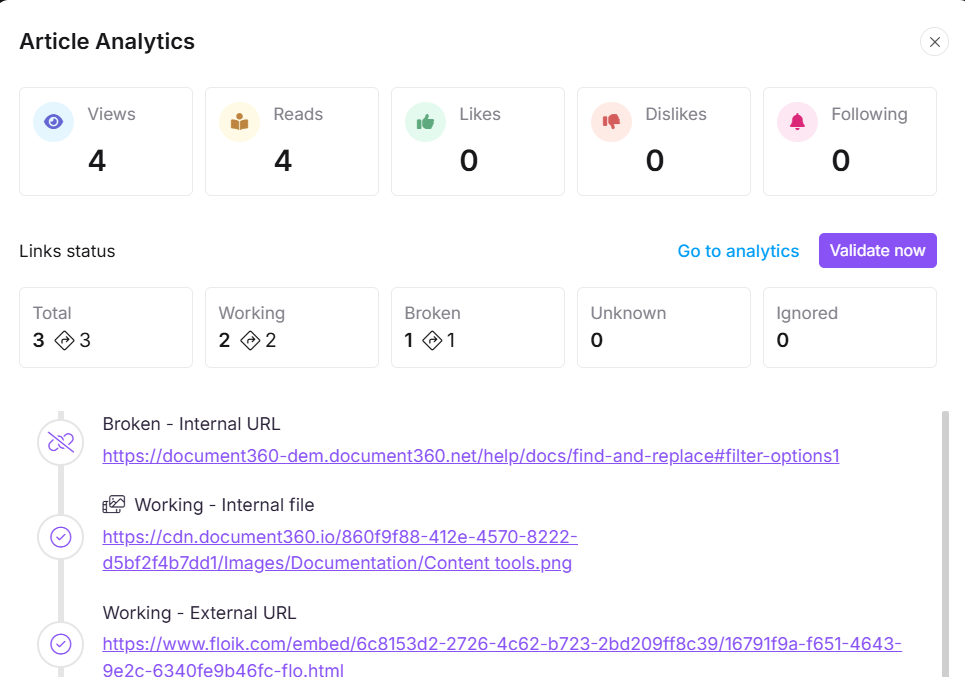
The article analytics panel opens, showing Views, Reads, Likes, Dislikes, Following, and Link status. - Click Go to analytics to open the project-level analytics for a broader view of your knowledge base's performance. For a full breakdown of project-level metrics, see Articles analytics.
Understand the metrics
Each metric gives you a different signal about how readers engage with the article.
| Metric | What it measures |
|---|---|
| Reads | Reader engagement, based on scrolling, clicking, and time spent on the article. Updates daily and counts once per day per user. |
| Views | The number of unique clicks per browser, counted once per browser per user. |
| Likes | The total number of likes, as feedback on content relevance. |
| Dislikes | The total number of dislikes, to help identify areas for improvement. |
| Following | The number of readers who follow the article on the knowledge base site. |
- For reads, time spent varies based on user activity, and multiple clicks on the same article in one session count as a single read.
- All metrics start tracking from the time the article is created.
Check and fix link status
The Link status section shows the total number of links in the article, then breaks them down by status:
| Status | Meaning |
|---|---|
| Total | The total number of links found in the article. |
| Working | The link works and points to the intended webpage or file, internal or external. |
| Broken | The link no longer works, due to a URL change, an incorrect URL, a removed page or item, or a restricted or private knowledge base article URL. Applies to URLs and media files. |
| Unknown | The link does not return a status. |
| Ignored | The link is excluded from the current or upcoming validation. |
- Click Validate now to check the link status automatically.
- Document360 lists every link in the article, grouped by status. Each entry shows the link type (for example, internal URL, internal file, or external URL) and the full URL.
- Identify any link listed under Broken, and copy its URL.
- Update the link, or set a redirect rule to guide readers to the correct destination.
For more information on redirecting article slug or url, read the article on Article redirect rule.
Best practices
- Run Validate now before publishing major edits, so broken links do not reach readers.
- Review articles with a high dislike count first when planning revisions, since they signal the biggest gap between reader expectation and content.
- Compare Reads against Views for a given article. A large gap between the two suggests readers open the article but do not engage with the content.
- Set a recurring check, for example monthly, on articles with the highest Following counts, since readers are actively tracking them for updates.
FAQ
How often is the analytics data updated?
Analytics data refreshes in real time, with reads updating daily based on unique user sessions.
Why might my read count differ from views?
Reads factor in engagement activities like scrolling and clicking, while views count unique browser clicks only.
Can I use article analytics to improve content engagement?
Yes. Metrics like Reads, Likes, and Dislikes show which articles resonate most with your audience, so you can decide where to focus revisions.
Can I see who followed an article?
No, you cannot view individual readers who follow an article. You can see the total follower count in the Following metric of article analytics.
What time period do the analytics figures in the panel cover?
The article analytics panel opened from More > Analytics in the article editor shows cumulative totals from the time the article was created, kept up to date in real time. It does not have a date-range filter. To view metrics for a specific period, such as last week, last month, or a custom range, click Go to analytics to open the project-level Articles analytics page and apply the Date filter.