The Reader analytics page in Document360 gives you a detailed view of how readers engage with your knowledge base. You can monitor individual reader activity, track article views and reads, and filter data by date, location, reader type, and more. Reader analytics is available only for private projects and private workspaces in mixed projects, helping teams understand content consumption patterns and identify gaps.
Why use reader analytics
Use Reader analytics when you need to:
- Monitor reader engagement — Identify which readers are most active and which articles they access frequently.
- Measure content effectiveness — Compare views and reads to understand whether readers are consuming content meaningfully, not just landing on pages.
- Track individual activity — Drill into a specific reader's history to see what they've viewed, read, liked, or disliked.
- Export engagement data — Download reader activity as a CSV for reporting or further analysis.
Before you begin
Before accessing the Reader analytics page, confirm the following:
- Project type: Reader analytics is available only for private projects and private workspaces in mixed projects. It is not available for public projects.
- Role: You must have a Project Owner or Admin role, or a custom role with access to analytics settings.
- Anonymization: If the Anonymize reader information setting is enabled (Settings () > Knowledge base portal > General > Analytics settings), the Reader analytics module becomes unavailable and reader-identifiable data is no longer displayed or tracked. Disable this setting to restore access. For more information, refer to General project settings.
Access and use reader analytics
Access the reader analytics page
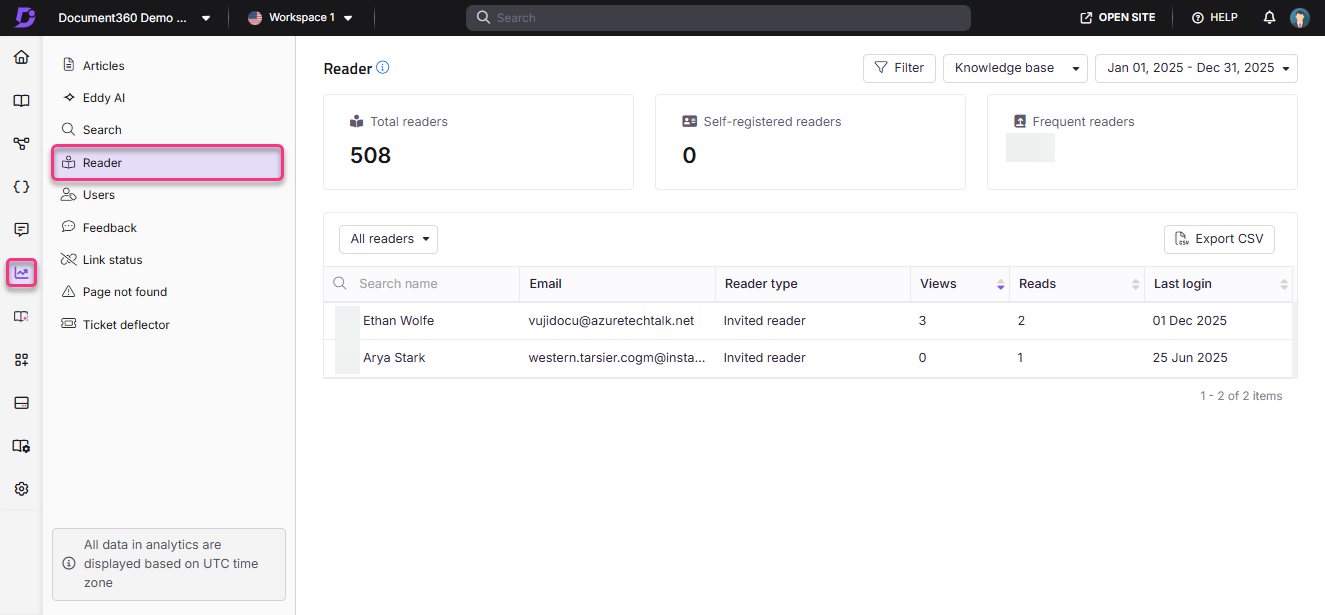
- In the Knowledge base portal, navigate to Analytics () in the left navigation bar.
- In the left navigation pane, click Reader.
Filter reader analytics data
By default, the page shows metrics for the last week. Use filters to adjust the date range and scope:
- Click the Date filter dropdown.
- Select a predefined range (for example, This month or Last month), or choose Custom to specify a date range.
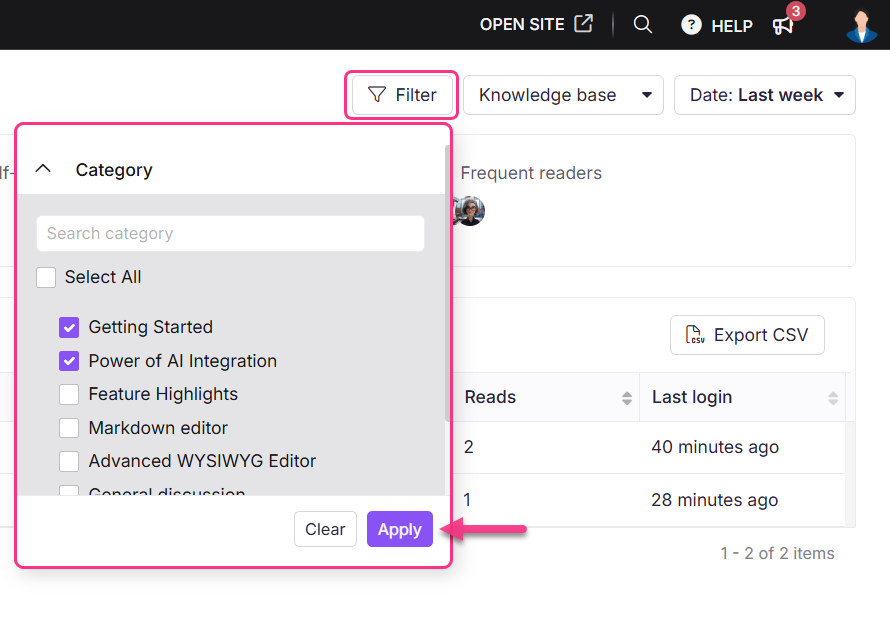
- Click Filter to narrow results by category and location within the Knowledge base workspace.
The custom date range you can select depends on your Document360 plan.
On the Business plan, the maximum custom date range is 3 months.
On the Enterprise plan, you can select and export a custom date range of up to 1 year.
To request a longer range, contact your Customer Success Manager or Document360 support.
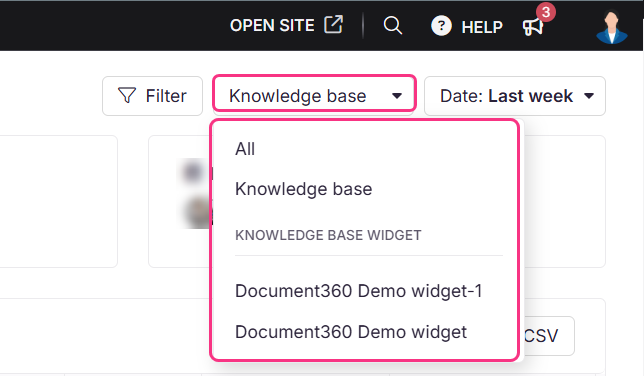
- If you are using the Knowledge base widget, use the top-right dropdown to switch between Knowledge base and Widget analytics.
- Select JWT widget to track reader interactions within private and mixed projects secured by JWT authentication. For more information, refer to Managing the Knowledge base widget.
- To filter by registration type, use the reader type dropdown to select All readers, Self-registration, SSO, JWT, or Invited readers.
Reader analytics data can take up to 15 minutes to reflect in the Knowledge base portal.
Understand the reader analytics overview
The Reader analytics page displays three metric tiles that reflect absolute data points for the selected date range.
| Metric | Description |
|---|---|
| Total readers | Number of readers added to your project who can access the knowledge base. |
| Self-registered readers | Readers who registered themselves on your knowledge base site. |
| Frequent readers | Readers who frequently access articles, calculated based on views and reads. If a reader is searched using the search field, they are updated in the frequent readers list. Hover over a reader badge to view their name or email ID (for JWT readers). |
View reader analytics data
The reader analytics table displays the following fields for the selected duration:
| Field | Description |
|---|---|
| Name | The reader's profile picture and name. Click the name to view detailed information including total views, reads, likes, dislikes, articles accessed, average time spent, and last viewed date. |
| The email address of the reader. | |
| Reader type | The reader's registration mode: Self-registration, SSO, JWT, or Invited. |
| Views | The number of times an article is accessed, counted once per browser session. See How views are counted for full details. |
| Reads | Recorded when a reader engages through scrolling, clicking, and spending time on a page. All three actions must occur. See How reads are counted for full details. |
| Last login | The date of the reader's most recent login. Click the reader's name to view detailed login activity. |
- Reader accounts do not have a 2-hour inactivity timeout like team users. Reader sessions follow a 24-hour rolling cookie expiry — readers are only logged out after 24 hours of continuous inactivity.
- The Last login timestamp updates only when a reader logs out and logs back in. Closing the browser tab or remaining logged in across sessions does not update the timestamp until a full logout and login cycle occurs.
- Team users have a built-in 2-hour inactivity timeout. When a user logs back in after this timeout — even without a manual logout — the Last login timestamp updates, ensuring regular activity tracking across days.
How views are counted
A view is recorded when an article loads in the browser, regardless of user interaction. The following rules apply:
- Multiple visits to the same article within a browser session count as one view, even across tabs, windows, or when a user closes and reopens the article within that session.
- If a user opens the same article in a different browser or device, clears cache, or refreshes the browser, it counts as an additional view.
- A browser session resets every 24 hours. Accessing the article after this period counts as another view.
How reads are counted
A read is recorded when a reader completes all three of the following actions:
- Scrolling: At least one scroll is required for a valid read.
- Time spent: A minimum of 40 seconds on the article. The timer pauses if the user becomes idle or switches tabs, and resumes upon return.
- Session tracking: Time spent revisiting the same article within 24 hours in the same browser session is added to the previous session's total.
Reads reflect meaningful interaction, distinguishing them from simple page loads.
View individual reader contributions
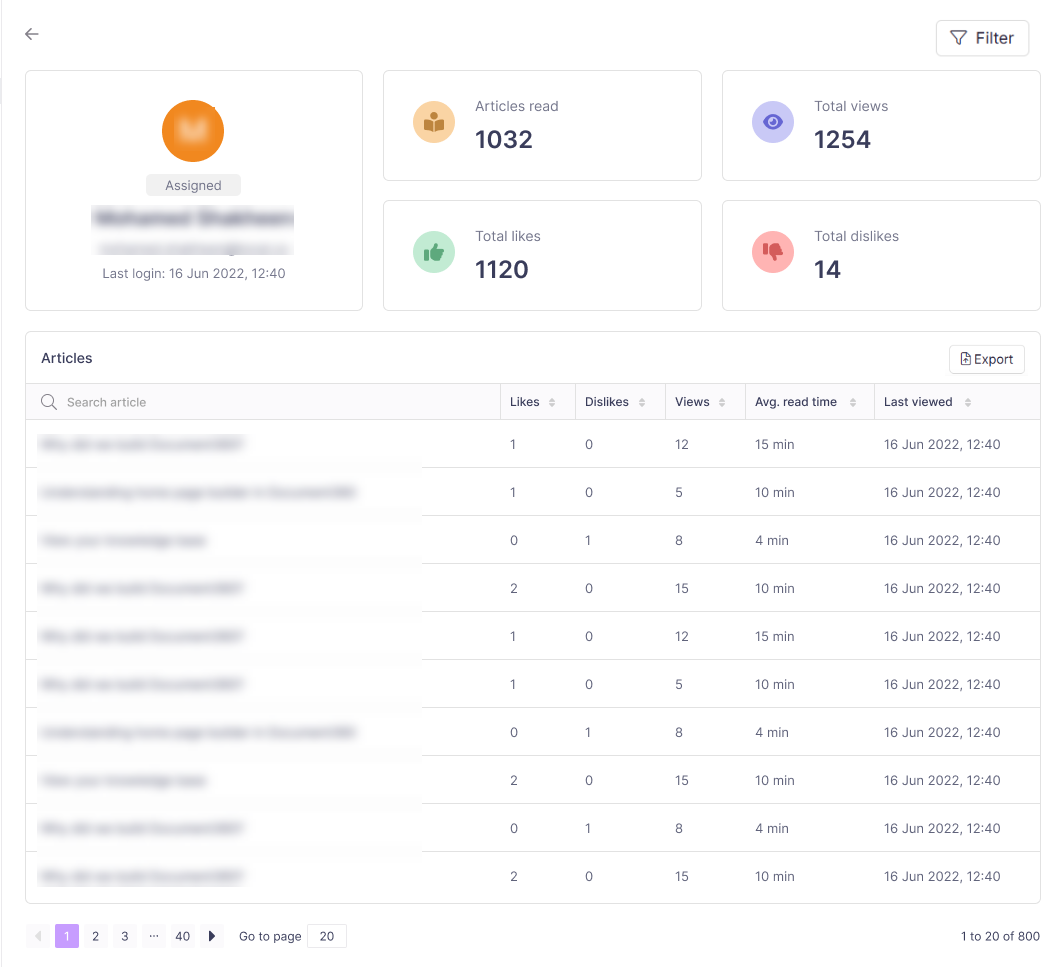
- Click a reader's name in the analytics table. The detail page displays:
- Profile: Name, profile image, email, portal role, and last login date and time (UTC).
- Contribution performance: Total views, total reads, total likes, and total dislikes.
- Articles: A list of article names the reader has accessed, along with views, reads, likes, dislikes, creation date, and last updated date.
- Export: Download the table as a CSV file to your local system.
When navigating from the main Reader analytics page to an individual reader's detail page, the applied date filter is retained. The data on the individual reader page reflects the same date range selected on the main page, ensuring consistency in view and read counts.
-
Click the Filter button at the top to refine the data by:
- Article type (All, Page, Article)
- Date (7 days, 30 days, Custom date)
- Read receipt status (All, Yes, No) — available only for Private and Mixed projects
- Category (all categories in the workspace)
-
Once done, click Apply.
-
Hover over an article title and click View in Knowledge base () to open the article in the knowledge base site.
Export reader analytics data
To export the full reader analytics table, click Export CSV on the Reader analytics page. The exported file includes all rows matching the currently applied filters and downloads in .csv format to your local system.
Best practices
- Drill into frequent readers — Click on your most active readers to understand which articles drive the most engagement and use that insight to improve or expand related content.
- Disable anonymization only when needed — If you need to use reader analytics, ensure the Anonymize reader information setting is disabled. Re-enable it when reader-level tracking is no longer required to maintain privacy standards.
- Monitor JWT readers separately — Use the JWT widget filter to isolate and track engagement from readers authenticated via JWT, which is especially useful for embedded or gated knowledge base deployments.
FAQ
Why is the Reader analytics page not available in my project?
Reader analytics is only available for private projects and private workspaces in mixed projects. It is not available for public projects. Also, if the Anonymize reader information setting is enabled under Settings > Knowledge base portal > General > Analytics settings, the Reader analytics module becomes unavailable. Disable this setting to restore access.
What is the difference between a view and a read?
A view is recorded whenever an article loads in the browser, once per browser session. A read requires the reader to scroll, spend at least 40 seconds on the article, and actively interact with it. Reads indicate meaningful engagement, whereas views only confirm that the page was opened.
How long does it take for reader activity to appear in the analytics dashboard?
Reader analytics data can take up to 15 minutes to reflect in the Knowledge base portal.
Why is the Last login timestamp not updating for a reader?
The Last login timestamp updates only when a reader logs out and then logs back in. Simply closing the browser tab or staying logged in across sessions does not trigger an update. Reader sessions follow a 24-hour rolling cookie expiry, so readers are only automatically logged out after 24 hours of continuous inactivity.
Can I export reader analytics data?
Yes. Click Export CSV on the Reader analytics page to download all rows matching the currently applied filters as a .csv file. You can also export an individual reader's article data from their detail page.