Add a video to an article or category page when a walkthrough is easier to follow than text. You can embed a video from a hosting platform such as YouTube, Wistia, or Vimeo, or insert one from Drive. The steps depend on your editor: the unified Editor, the Advanced WYSIWYG editor, or the Markdown editor.
NOTE
The unified Editor is rolled out in phases and is currently available in projects created on or after November 23, 2026. Projects created earlier continue to use the Advanced WYSIWYG editor and the Markdown editor. We're working to make it available to all projects soon.
Insert a video in the unified Editor
In the unified Editor, you insert a video from the toolbar or the slash menu in Block view.
- Open the article in edit mode.
- Place your cursor where you want the video.
- Open the Insert video dialog in either of these ways:
- In the toolbar, select the arrow next to Insert image (More insert options), then select Video.
- Type
/videoand select Video.
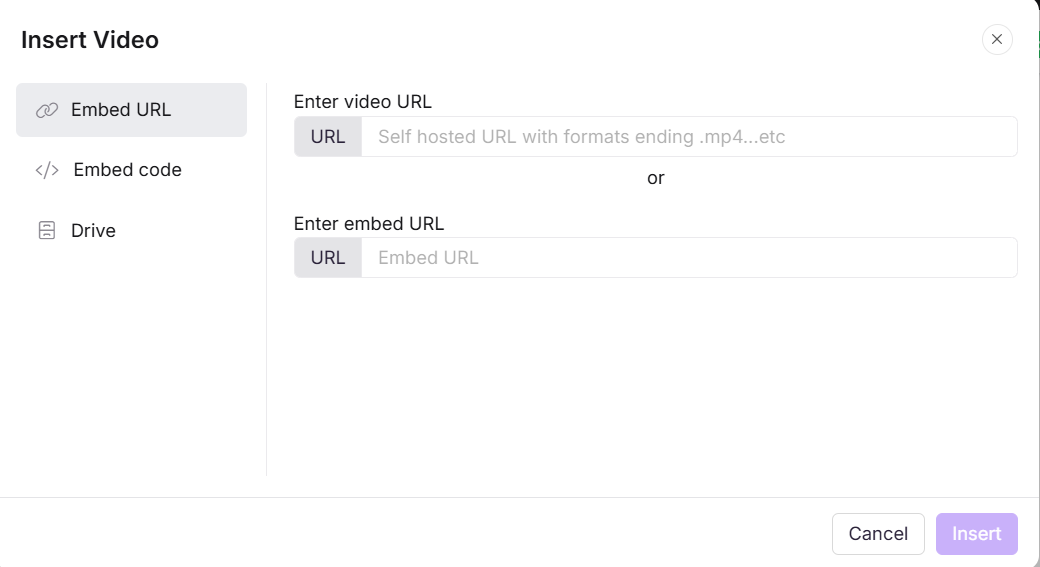
- Choose how to add the video:
- To use a self-hosted video file, such as an
.mp4, select Embed URL and paste the file URL in Enter video URL. - To embed a video from YouTube, Wistia, or Vimeo, select Embed URL and paste the platform's embed URL in Enter embed URL.
- To paste an embed code snippet from the hosting platform, select Embed code and paste it in Enter code.
- To use a video already stored in Drive, select Drive and choose the video.
- To use a self-hosted video file, such as an
- Select Insert.
In the unified Editor, you can't upload a video from your device in the Insert video dialog. To use a video file on your computer, upload it to Drive first, and then select it from the Drive tab.
To record a product video instead, select Document360 Engage in the toolbar, or type / and choose Screen capture, Explainer video, or Interactive video on the Insert tab.
In Markdown view in the unified Editor, a video file is written as an image with video settings:
{width="640" height="360" data-video="true"}
Insert a video in the Advanced WYSIWYG editor
- Open the article in the Advanced WYSIWYG editor.
- Use the slash command
/videoand select Video. The Insert video panel appears. - Choose how to add the video:
- To embed a video from YouTube, Wistia, or Vimeo, select Embed URL and paste the platform's embed URL in Enter embed URL.
- To use a self-hosted video file, such as an
.mp4, select Embed URL and paste the file URL in Enter video URL. - To paste an embed code snippet from the hosting platform, select Embed code. Keep only the
<iframe>tag. For more information, see Vimeo embed code doesn't work. - To use a video already stored in Drive, select Drive and choose the video.
- Select Insert.
The video appears in the editor. If you used a self-hosted video URL, resize the video to set its height and width.
Add a caption to a video
Add a caption to tell readers what a video shows or which step it supports. The caption appears below the video. You can add captions in the unified Editor and the Advanced WYSIWYG editor. The Markdown editor doesn't support video captions.
- Select the video in the article.
The floating menu appears. - Select Caption.
A caption field appears below the video. - Enter the caption.
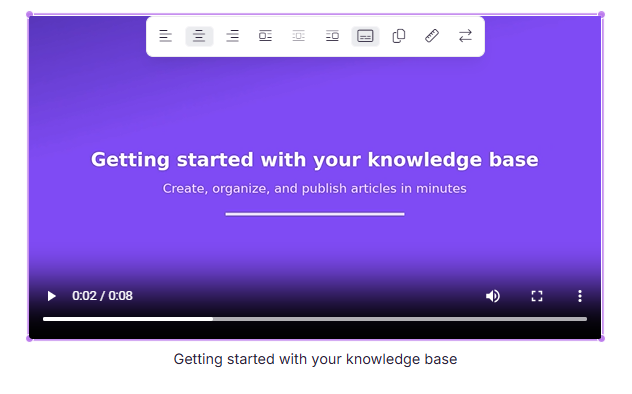
To remove the caption, select the video and select Caption again. This deletes the caption text.
You add a caption after you insert the video. The Insert video panel doesn't have a caption field.
A caption works with the other alignment options. When you change the alignment of a captioned video, the caption moves with it.
You can't use a caption with Inline block (Advanced WYSIWYG editor) or Inline center (unified Editor). When a video has a caption, that option is unavailable, and when a video uses it, Caption is unavailable. To switch, turn off the one you're using first.
Insert a video in the Markdown editor
In the Markdown editor, you can paste a video URL or select a video already stored in Drive.
Insert a video by URL
- Open the article in the Markdown editor.
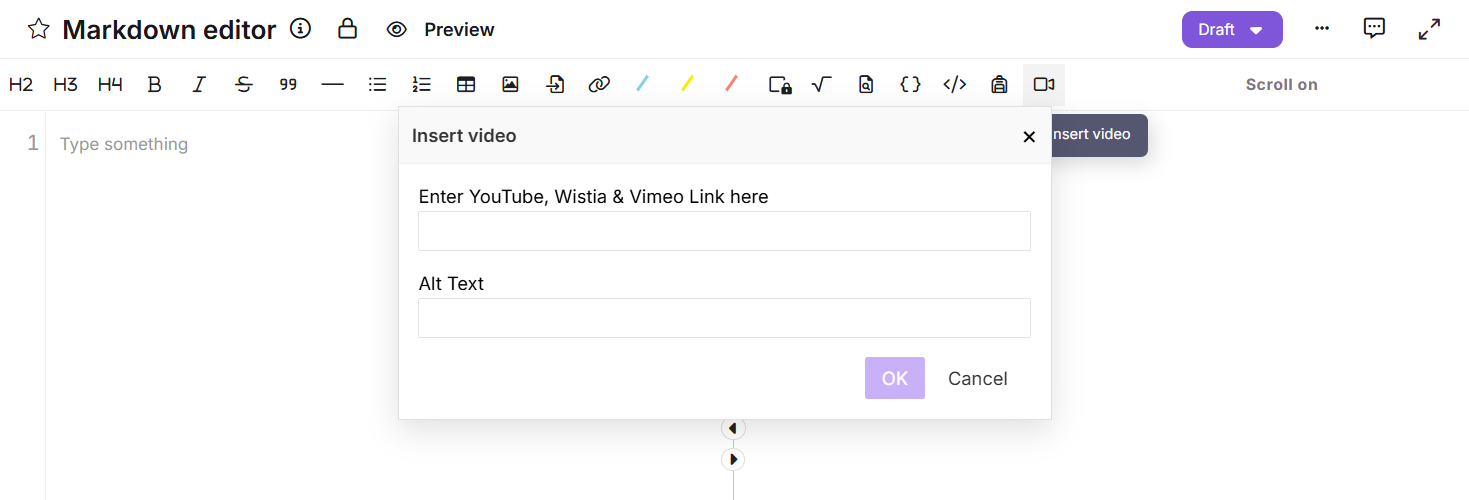
- Select the Insert video () icon in the toolbar. The Insert video panel appears.
- Paste the video URL (YouTube, Wistia, or Vimeo) in the first text field.
- Enter alt text for the video in the Alt Text field.
- Select OK.
Insert a video from Drive
- Open the article in the Markdown editor.
- Select the Insert file () icon in the toolbar.
- Select the video from Drive and select Insert.
- Update the pixel height and width as needed.
Best practices
- In the Advanced WYSIWYG editor, use Enter embed URL for hosted videos (YouTube, Wistia, Vimeo) instead of pasting an embed snippet with wrapper tags. Only the
<iframe>tag is supported. - In the Advanced WYSIWYG editor, test any pasted embed code before you publish, to confirm that slash commands, image editing, and other content blocks still work in the article.
- Use link analytics to check for broken video links across your articles.
- Add descriptive alt text to every video, for accessibility and search.
- Add a short caption when a video needs context, such as what it demonstrates or which step it supports.
Troubleshooting
Vimeo embed code doesn't work
In the Advanced WYSIWYG editor, if you paste a Vimeo embed code and the video doesn't appear, or slash commands (/), image editing options, or content blocks stop working in the article, the embed code may contain unsupported tags. Vimeo embed codes often include <div> and <script> tags or styling wrappers. Document360 supports only the <iframe> tag for embedding videos.
To fix the embed code:
- Remove everything except the
<iframe>tag. - In the iframe's
styleattribute, changeposition:absolutetoposition:relativeand removetop:0;left:0;so the video displays correctly.
Before (unsupported code):
<div style="padding:56.25% 0 0 0;position:relative;">
  <iframe src="https://player.vimeo.com/video/<video-id>?badge=0&autopause=0&player_id=0&app_id=58479"
  frameborder="0" allow="autoplay; fullscreen; picture-in-picture; clipboard-write; encrypted-media"
  style="position:absolute;top:0;left:0;width:100%;height:100%;"
  title="Product walkthrough"></iframe>
</div>
<script src="https://player.vimeo.com/api/player.js"></script>
After (supported code):
<iframe src="https://player.vimeo.com/video/<video-id>?badge=0&autopause=0&player_id=0&app_id=58479"
frameborder="0" allow="autoplay; fullscreen; picture-in-picture; clipboard-write; encrypted-media"
style="position:relative;width:100%;height:100%;"
title="Product walkthrough"></iframe>
FAQ
Where is the video option in the unified Editor?
In the toolbar, select the arrow next to Insert image, then select Video. You can also type /video in Block view and select Video.
Can I upload a video from my computer in the unified Editor?
No. The Insert video dialog in the unified Editor has Embed URL, Embed code, and Drive, but no option to upload from your device. Upload the video to Drive first, and then select it from the Drive tab.
Why is Inline block or Inline center unavailable for my video?
The video has a caption. A caption can't be used with Inline block (Advanced WYSIWYG editor) or Inline center (unified Editor). Turn off Caption to use that option, or choose another alignment option.
Can I find broken video links in my articles?
Yes. Link analytics checks your project's links, including media files, videos, and images. For more information, see Link status.
Can I filter articles that contain embedded videos?
No. There's no built-in filter for articles with embedded videos. To find them, check the articles manually.