You can make specific hyperlinks stand out by giving them a larger font size than the surrounding text. This uses a CSS class that you define once in Custom CSS settings, then apply selectively to individual links in your articles using an HTML <a> tag. Only links tagged with the class are affected; all other hyperlinks remain unchanged.
When to use custom hyperlink font sizes
- Call-to-action links: make a key link (such as "Get started" or "View pricing") visually larger to draw readers' attention.
- Important references: highlight a critical external link or cross-article reference so it stands out from surrounding body text.
NOTE
This approach is per-link, not global. Only hyperlinks that include class="CustomLink" in their HTML tag are affected. Standard Markdown links and other hyperlinks are unchanged.
Quick reference
CSS snippet paste once in Custom CSS settings. Replace 25px with your desired font size:
.CustomLink {
    font-size: 25px;
}
Per-link HTML use in your article instead of a standard Markdown link. Replace the URL and link text:
<a class="CustomLink" href="https://www.document360.com/">Document360</a>
How to add a custom font size to a hyperlink
Add the CSS class
- In the Knowledge Base portal, go to Settings > Knowledge base site > Custom CSS & JavaScript.
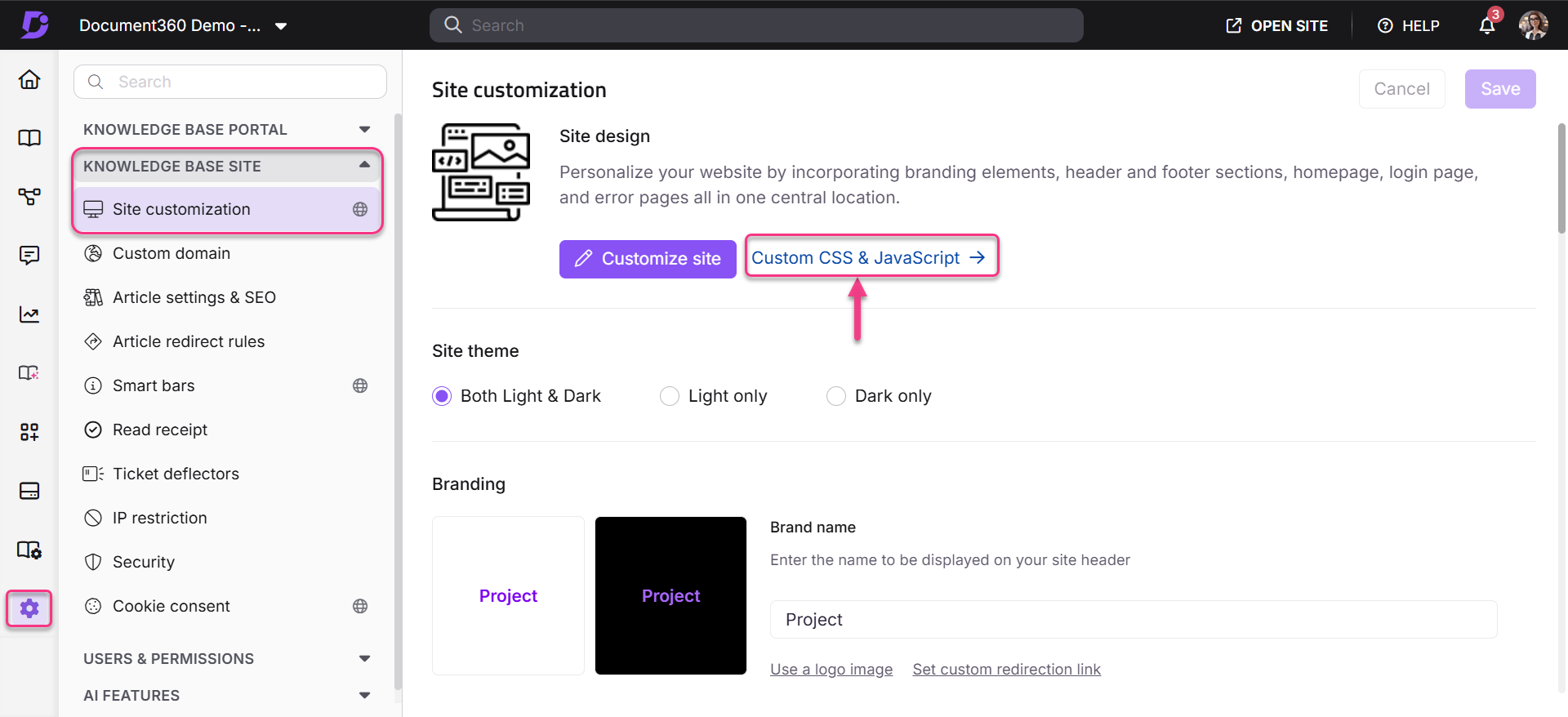
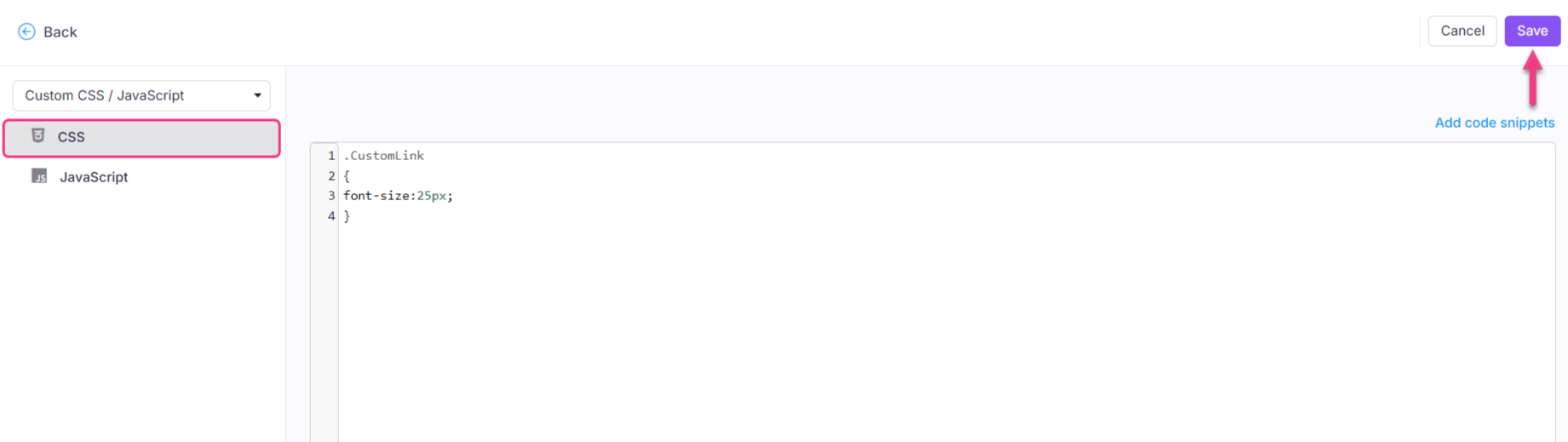
- Select the CSS tab and paste the following snippet:
.CustomLink {
    font-size: 25px;
}
- Replace
25pxwith your desired font size. - Click Save.
Apply the class to a link in your article
- Open the desired article and place your cursor where you want the styled link to appear.
- Paste the following HTML, replacing the URL and link text with your own:
<a class="CustomLink" href="https://www.document360.com/">Document360</a>
- Replace
https://www.document360.com/with your desired link URL. - Replace
Document360with your desired link text.
Scope and coverage
| Item | Detail |
|---|---|
| Scope | Per-link, only <a class="CustomLink"> tags are affected |
| Default font size example | 25px adjust to match your design needs |
| Works in | Markdown editor (inline HTML) and Advanced WYSIWYG editor (code view) |
| Other hyperlinks | Unaffected, standard Markdown links and other HTML links remain unchanged |
Best practices
- Keep the class name consistent:
CustomLinkis used throughout this example. If you rename the class in the CSS, update every<a>tag in your articles to match. - Use sparingly: enlarged links draw attention precisely because they are different from surrounding text. If too many links use a large font size, the effect is lost, and the page becomes visually inconsistent.
- Match font size to context:
25pxis significantly larger than standard body text (typically 14–16px). For a subtle emphasis, consider18pxor20pxinstead. - Extend the class for other properties: you can add more CSS properties to
.CustomLinkbeyond font size, such asfont-weight: boldorcolor: #1a73e8, to create a fully custom link style in one place. - Test in both Light and Dark mode: if your knowledge base supports Dark mode, verify the styled link is readable against both backgrounds.