IP-beperking voegt een extra beveiligingslaag toe aan je kennisbank door toegang toe te staan of te beperken op basis van door de gebruiker opgegeven IP-adressen.
OPMERKING
Dit is een projectniveau-setting . Zodra het is ingeschakeld, geldt het voor alle werkruimtes en talen binnen dat project.
Document360 ondersteunt zowel IPv4 - als IPv6 (Unicast) -adressen.
Toegang tot de IP-beperkingspagina
- Navigeer naar Instellingen () > kennisbanksite in de linker navigatiebalk van het kennisbankportaal.
- Navigeer in het linker navigatiepaneel naar IP-beperking.
De IP-beperkingspagina toont de volgende velden:
| Veld | Beschrijving |
|---|---|
| Status | De actieve status van een IP-beperking. Gebruik de schakelaar om een reeds toegevoegde beperking aan of uit te zetten. Wanneer actief is het Toestaan-label groen en het Blok-label rood. Wanneer inactief, zijn beide labels grijs. |
| Voeg mijn huidige IP-adres toe | Klik om automatisch je huidige IP-adres te detecteren en toe te voegen |
| Vriendelijke naam | Voer een naam in om de IP-beperking te identificeren (geen tekenlimiet) |
| IP-adres | Voeg een specifiek IP of bereik toe (ondersteunt IPv4 en IPv6) |
| Toestaan/blokkeren | Kies of je het ingevoerde IP-adres of -bereik toestaat of blokkeert |
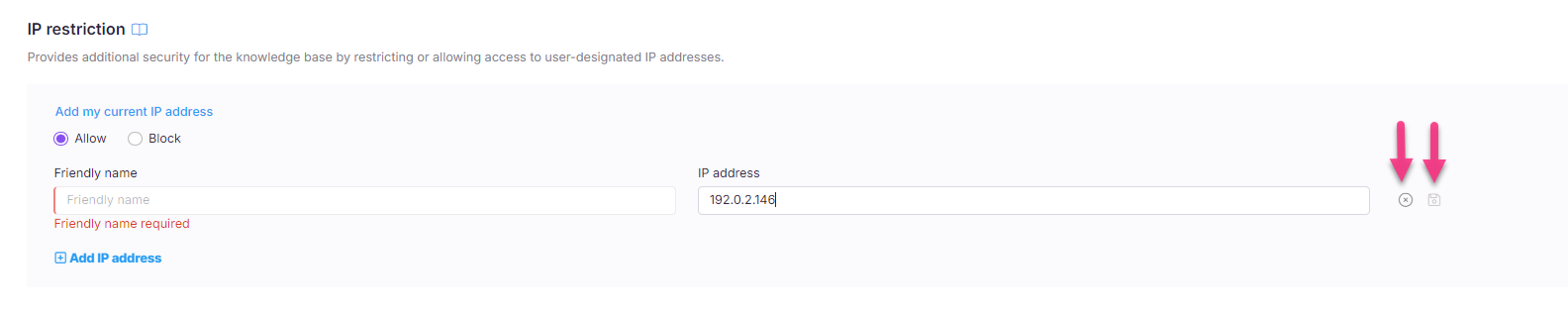
| Verwijderen () | Verwijder de beperking |
| Sla op () | Sla je wijzigingen in je IP-beperkingen op |
.png)
Toevoeging van een IP-beperking
-
Klik op IP-adres toevoegen.
-
Voer een naam in in het veld Vriendelijke naam (verplicht).
-
Voer een geldig IP-adres of bereik in.
Voorbeeld van een bereik:
79.15.135.189 - 79.15.135.229 -
Klik op het opslaan ()-icoon.
-
Om ingevoerde gegevens te wissen, klik je op het Reset () icoon.
-
Klik op Voeg mijn huidige IP-adres toe om je momenteel gebruikte IP-adres toe te voegen.
Ondersteunde IPv6-formaten
| Format | Status |
|---|---|
2001:0db8:85a3:0000:0000:8a2e:0370:7334 |
✅ Geldig |
2001:0db8:85a3::8a2e:0370:7334 |
❌ Ongeldig |
2001:db8:85a3:0:0:8a2e:370:7334 |
✅ Geldig |
Sta een IP-adres toe of blokkeer
Voor elke IP-beperking kun je kiezen uit twee opties:
- Toestaan: Verleent toegang tot de kennisbanksite vanaf het opgegeven IP-adres of bereik.
- Blokkeren: Beperkt de toegang vanaf het opgegeven IP-adres of bereik.
OPMERKING
Als hetzelfde IP-adres wordt ingevoerd voor zowel Toestaan als Blokkeren, of meer dan eens wordt toegevoegd, verschijnt er een waarschuwing: "Er bestaat al een beperking met dit IP-adres."
Sta mijn IP-adres toe
Je kunt het IP-adres van je huidige apparaat aan de toegestane lijst toevoegen op twee methoden.
Van de overzichtspagina van IP-beperkingen
Op de IP-beperkingspagina (Instellingen > IP-beperking) klik je rechtsboven naast de knop Nieuw IP-beperking op Toestaan van mijn IP. De beperking wordt direct aan de lijst toegevoegd.
Vanuit het Add IP beperkingspaneel
Klik op Nieuwe IP-beperking om het paneel te openen. Klik op Voeg mijn huidige IP-adres toe boven het IP-adresveld om het in te vullen met je huidige IP. Klik op Toevoegen om op te slaan.
Een IP-beperking bewerken
Om een IP-beperking te bewerken, klik je op het Bewerken-icoon naast de IP-beperking in de lijst. De volgende velden zijn bewerkbaar:
- Vriendelijke naam
- IP-adres
- Toestaan/blokkeren IP
Zodra de bewerking voltooid is, klik je op het ✔ icoon om de wijzigingen op te slaan.
WAARSCHUWING
Wees heel voorzichtig bij het uitvoeren van de bewerkingsactie. Zodra het is gewijzigd en opgeslagen, zal het IP-beperkingsrecord de bestaande data overschrijven.
OPMERKING
De Bewerken-knop is uitgeschakeld als de statusschakelaar van de beperking is uitgeschakeld. Je kunt alleen actieve beperkingen bewerken. De Delete-knop werkt voor zowel actieve als inactieve beperkingen.
Een IP-beperking verwijderen
Om een IP-beperking te verwijderen, klik je op het Verwijderen ()-icoon naast het IP-adres.
Er verschijnt een bevestigingsbericht: IP-beperking verwijderd.
OPMERKING
Het verwijderen van een IP-beperking is permanent en kan niet worden teruggedraaid.
FAQ
Wat is een IP-adres?
Een IP-adres (Internet Protocol-adres) is een uniek nummer dat een apparaat op een netwerk identificeert en het in staat stelt gegevens via het internet te verzenden of ontvangen.
Wat is een IPv4-formaat?
Een IPv4-adres heeft vier groepen nummers (0–255) gescheiden door puntjes.
Voorbeeld: 49.206.113.170
Wat is een IPv6-formaat?
Een IPv6-adres gebruikt 128-bits opmaak en bevat hexadecimale waarden gescheiden door dubbele punten.
Voorbeeld:
FE38:DCE3:124C:C1A2:BA03:6745:EF1C:683DStart van het bereik:
0000:0000:0000:0000:0000:0000:0000:0000Einde van het bereik:
ffff:ffff:ffff:ffff:ffff:ffff:ffff:ffff
Wat is een IPv6 unicast-adres?
Een IPv6 unicast-adres identificeert één specifiek apparaat op een netwerk. Wanneer data naar dit adres wordt gestuurd, gaat deze direct naar dat ene apparaat — zodat punt-tot-punt-communicatie wordt gegarandeerd. Dit verschilt van multicast (one-to-many) of anycast (one-to-naarest) adressen, die worden gebruikt voor bredere of geoptimaliseerde levering.