The Article feedback manager in Document360 collects two types of reader input: direct feedback on articles or categories, and queries that returned no search results. Understanding both types helps your team identify not only what readers found unhelpful, but also what they were looking for and could not find. This article explains how readers submit each type of feedback from the knowledge base site and what is captured in the portal.
How readers submit article feedback
At the end of each article, readers can indicate whether the content was helpful.
- Yes (): Selecting Yes counts as a Like for the article. Readers can optionally add a comment.
- No (): Selecting No counts as a Dislike for the article. Readers can choose a reason and provide additional comments.
The available dislike reasons are:
- Need more information
- Inaccurate or irrelevant content
- Difficult to understand
- Missing/broken link
- Others
The comment input box displays up to five lines of text without scrolling. Readers can add up to 1,000 characters, including spaces. A character counter is displayed below the input box. Readers can also opt in for updates by selecting the Notify me about updates checkbox, then click Submit.
For public projects, readers must manually enter their email addresses. For private and mixed projects, the Email field is automatically prefilled for logged-in users.
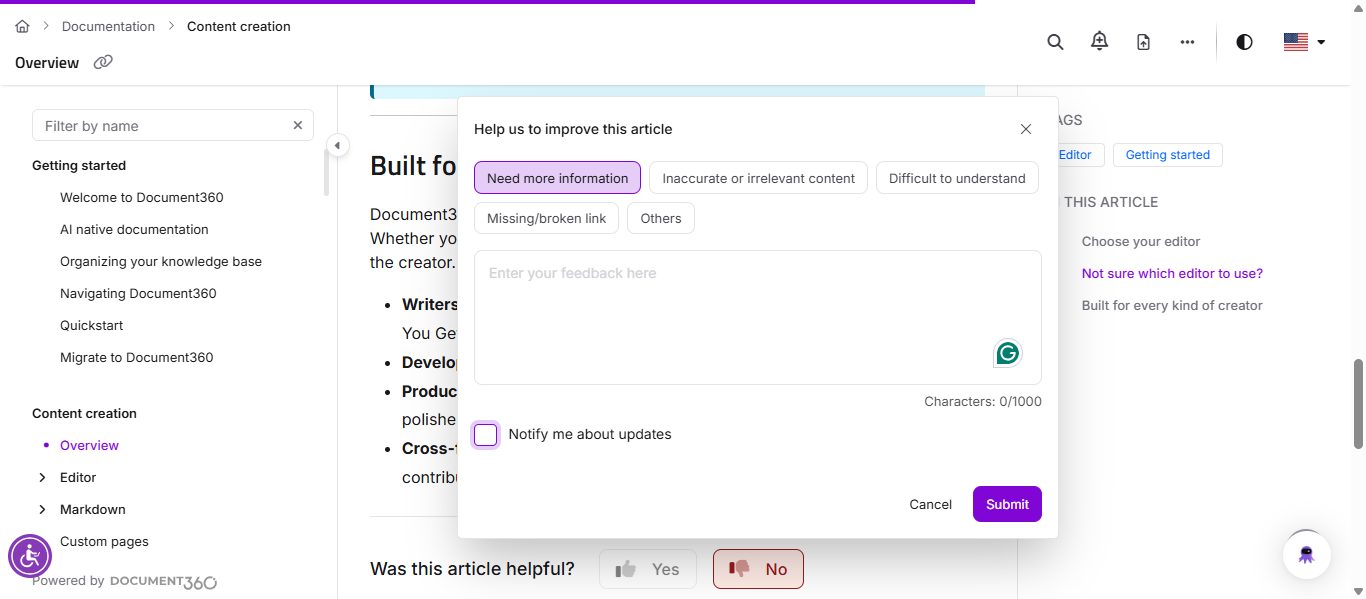
The latest recorded response, whether Yes or No, will be captured in the Feedback tab. For instance, if a reader first selects Yes and later changes their response to No, only the No response will be recorded in the Feedback manager.
What the Feedback tab shows in the portal
The Feedback tab in the Article feedback manager displays all article-level feedback received from readers.
The Total feedback count reflects the total number of Open, Planned, and In Progress feedback items. This count updates dynamically as feedback arrives or filters are applied.
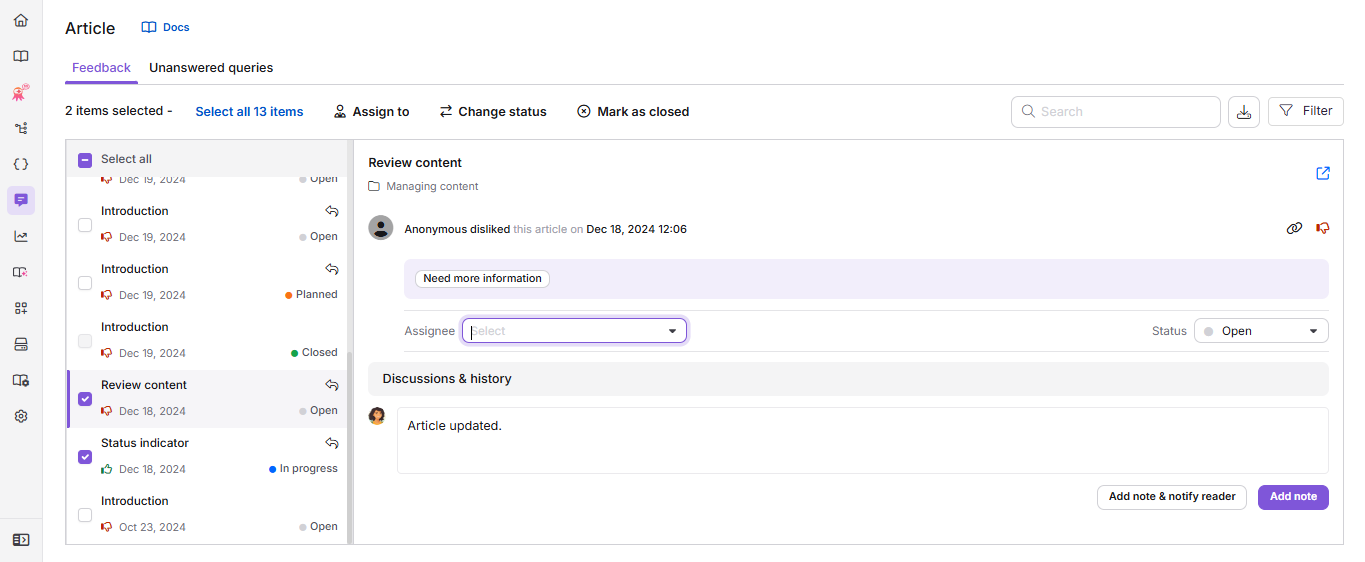
The Feedback tab shows the following elements:
- () Assign to: Click to set an assignee and the status of the feedback.
- () Change status: Click to change the status of the feedback.
- Search feedback: Use the search field to search for feedback.
- Export CSV (): Click to export and download the feedback data as a CSV file. Data from the last 90 days is available.
- Filter: Click to filter feedback by:
- Application (Both, Knowledge base, Knowledgebase assistant)
- Assigned to: filter by a contributor name
- Feedback type (Select all, Dislike, Like)
- Status (Select all, Open, Planned, In Progress, Complete, Closed)
- Date range (All, 7 days, 30 days, 3 months, 1 year, Custom date)
- Select feedback: Click the checkbox next to a feedback item to access action options. Use Select all items to select the entire list.
- Mark as closed (): Select one or more feedback items using the checkboxes, then click this to close them. This opens a confirmation popup where you can optionally type a comment, then choose Close all feedback to close the items silently, or Close & notify reader to close them and email your comment to each reader.
- Article name & category: Displays the article name that received the feedback and the respective category.
- Feedback details: Displays the reader's email ID, feedback type, and the date and time of the feedback.
- Feedback comment: Displays the comment added along with the feedback.
- Assignee: Select the assignee from the dropdown to assign the feedback to a team member.
- Discussion & history: Displays the internal discussion thread and action history for the feedback.
- Click Add note to add comments and replies visible only to internal users.
- Click Add note & notify reader instead to also email your response to the reader.
- Once done, click Send.
- Copy link (): Click to generate a unique shareable URL for that specific feedback item. Sharing this link takes the recipient directly to the feedback item. Users without the required access permissions will see an access restriction message. This will also be reflected when navigated from Analytics, Dashboard, and Email.
- Feedback icon: Displays the type of feedback: Like or Dislike .
- Status: Click to set the status of the individual feedback.
How readers submit unanswered query feedback
When a reader performs a search that returns no results, they can submit feedback about what they were looking for.
- Readers can describe what they searched for in the text field.
- They can opt in for updates by selecting the Notify me about updates checkbox, then click Submit.
For public projects, readers must manually enter their email addresses. For private and mixed projects, the Email field is automatically prefilled for logged-in users.
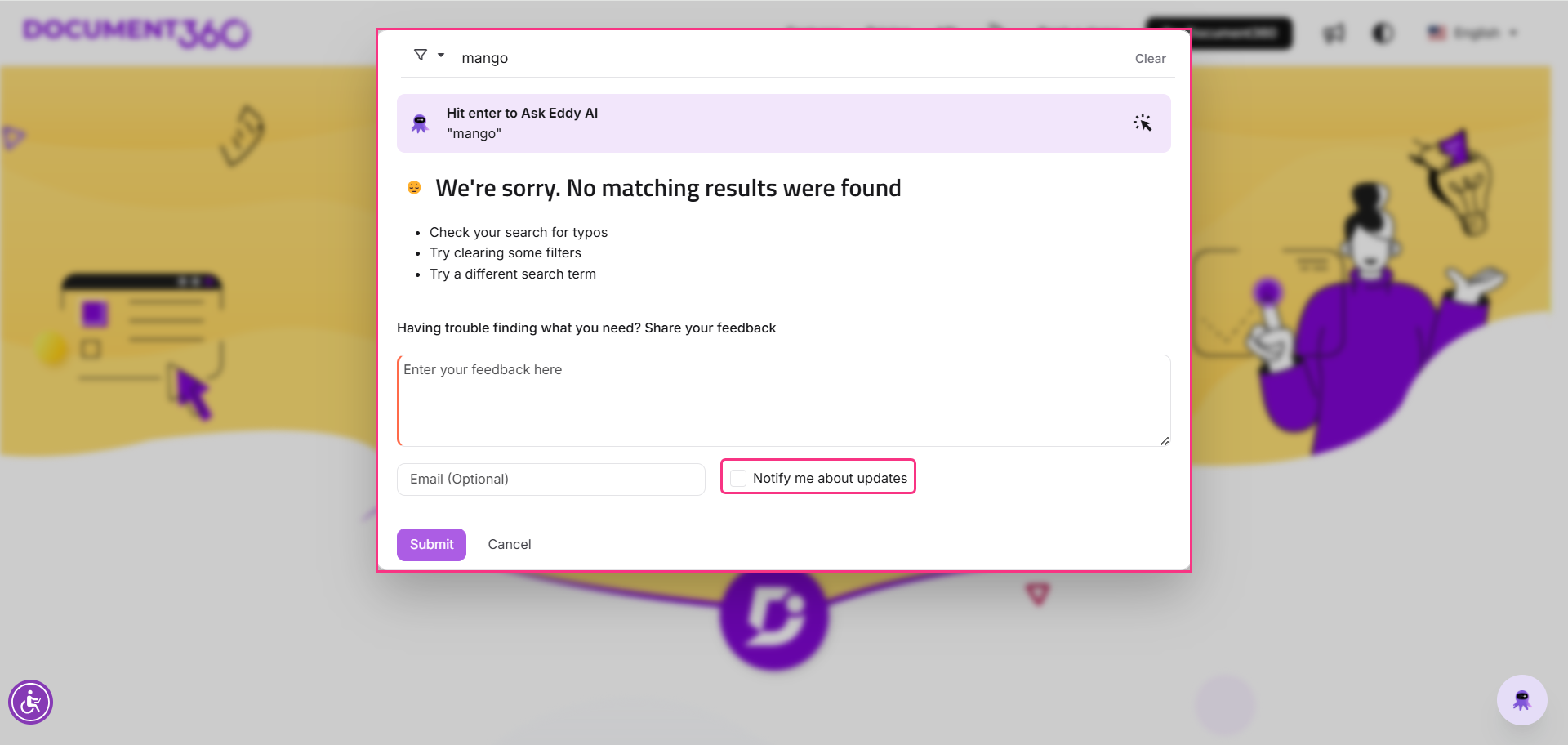
Regularly review the Unanswered queries tab to uncover missing keywords or topics that could be added to your content.
What the Unanswered queries tab shows in the portal
The Unanswered queries tab captures all feedback submitted when readers received no search results.
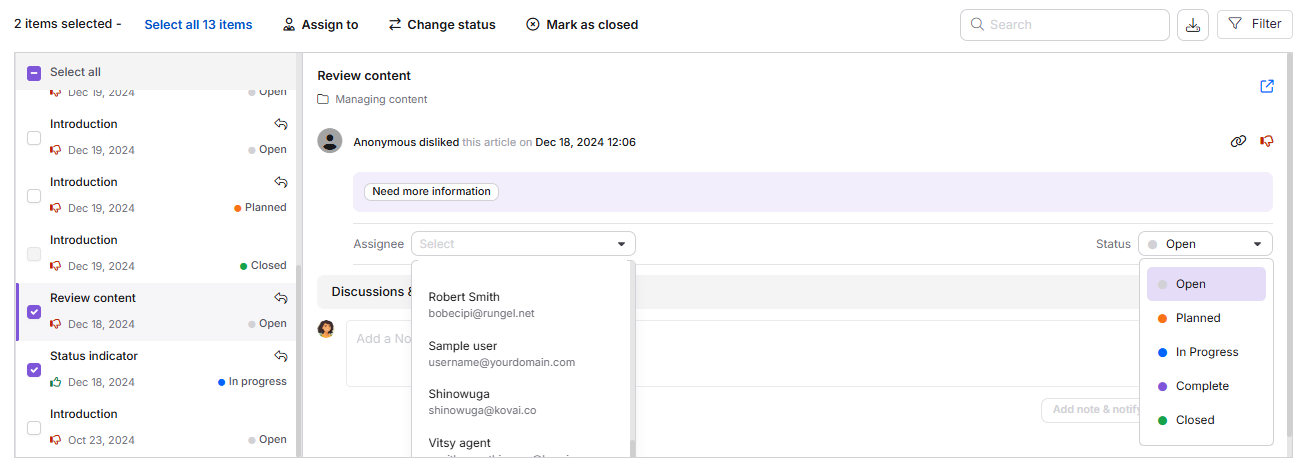
The Unanswered queries tab shows:
-
Select feedback: Click the checkbox of a feedback to access bulk action options. Use the Select all checkbox to select all feedback.
-
Assign to: Click to set an assignee and the status of the feedback.
Change status: Click to change the status of the feedback.
-
Mark as closed (): Select one or more feedback items using the checkboxes, then click this to close them. This opens a confirmation popup where you can optionally type a comment, then choose Close all feedback to close the items silently, or Close & notify reader to close them and email your comment to each reader.
-
Search feedback: Use the search field to search for feedback.
Export CSV : Click to export and download the feedback data for external analysis and purposes from the last 90 days.
Filter: Click to filter feedback by:
- Application (Both, Knowledge base, Knowledgebase assistant)
- Assigned to — filter by a contributor name
- Feedback type (Select all, Dislike, Like)
- Status (Select all, Open, Planned, In Progress, Complete, Closed)
- Date range (All, 7 days, 30 days, 3 months, 1 year, Custom date)
-
Search query: Displays the search query that received the feedback.
-
Feedback details: Displays the reader's email ID, feedback type, and the date & time of the feedback.
-
Feedback comment: Displays the comment added along with feedback.
-
Assignee: Select the assignee from the dropdown to assign the feedback to.
Status: Click to set the status of the individual feedback.
-
Discussion & history: This section displays the internal discussions and history log of the feedback.
- Click Add note to add comments and replies visible only to internal users.
- Click Add note & notify reader instead to also email your response to the reader.
- Once done, click Send.
Best practices
- Check the Unanswered queries tab weekly to identify content gaps: if readers cannot find what they are searching for, consider creating a new article or adding keywords to an existing one.
- Review dislike feedback with comments first, as these provide the most actionable detail about what needs to change.
- Use the Filter options to narrow feedback by date range or feedback type, especially after a major content update, to see whether changes improved satisfaction.
- Keep the Email field in your project settings configured so readers with the Notify me about updates checkbox selected receive responses.
FAQ
Is there a character limit for feedback provided by readers?
Yes, readers can provide up to 1,000 characters of feedback, regardless of whether it is positive or negative. The limit includes spaces, and formatting options such as bold, italics, or bullet points are not supported. A character counter is displayed below the input box.
Can I customize the feedback reasons available when a reader selects a dislike for an article?
The feedback reasons (such as Need more information, Inaccurate or irrelevant content, Difficult to understand, Missing/broken link, or Others) are currently not customizable. To request a customization, reach out to the support team.
What is the difference between the Feedback tab and the Unanswered queries tab?
The Feedback tab collects reader reactions (likes, dislikes, and comments) submitted at the end of an article. The Unanswered queries tab captures feedback submitted when a reader searched for something and received no results. Both are in the Article feedback manager and share similar management tools.
Will a reader's email be captured if they do not opt in for updates?
For public projects, the email field is optional unless the reader selects Notify me about updates. For private and mixed projects, the email field is automatically prefilled for logged-in users, regardless of whether they opt in for updates.