Microsoft Teams is a notification channel in Document360 that delivers Knowledge base portal, site, and widget notifications directly to a Teams channel of your choice. Instead of checking Document360 manually, your team receives instant alerts whenever articles are published, updated, or changed — keeping everyone aligned without switching tools. You configure the channel once using a Power Automate Workflow webhook URL, then control exactly which events trigger notifications through the Notification mapping settings.
Microsoft has deprecated the Incoming Webhook connector (Office 365 Connector) for Microsoft Teams. The recommended replacement is Power Automate Workflows. If you previously configured notifications using the Incoming Webhook connector, follow the migration instructions below. If you are setting this up for the first time, follow the new setup instructions below.
When to use the Microsoft Teams notification channel
Use this integration when your team relies on Microsoft Teams as their primary communication hub and needs to stay informed about knowledge base activity without logging into Document360. Common scenarios include:
- Team-wide announcements — Broadcast knowledge base changes to the whole team through a dedicated documentation channel whenever an article is published or updated.
- Multiple audiences — Route different notification types to separate Teams channels for different teams using Notification mapping.
Before you begin
- You have Owner or Admin access to the Document360 Knowledge base portal.
- You have access to the Microsoft Teams workspace where the target channel exists or can be created.
- You have access to Power Automate (included with most Microsoft 365 plans) to create a workflow.
How to set up the Microsoft Teams notification channel
Setting up Microsoft Teams notifications involves three steps: creating the Teams channel, generating a webhook URL via Power Automate Workflows, and configuring the channel in Document360.
Step 1: Create a channel in Microsoft Teams
- Open Microsoft Teams.
- Go to Teams (), then select the More (⋯) icon next to the team where you want to add the channel.
- Click Add channel.
- Enter the channel name and click Add.
For more information, see Create a standard, private, or shared channel in Microsoft Teams.
Step 2: Obtain the webhook URL via Power Automate Workflows
- In the newly created channel, click the More (⋯) icon and select Workflows.
- In the Workflows panel, search for and select the template Post to a channel when a webhook request is received.
- In the search bar, type Incoming webhook and click Add.
- Enter a name for your workflow, verify the connection account shown, and click Next.
- Select the Team and Channel where notifications should be posted, then click Create.
- Once the workflow is created, a unique webhook URL is generated.
- Click Copy to save the webhook URL to your clipboard.
- Click Done.
For more information, see Create incoming webhooks with Workflows for Microsoft Teams – Microsoft Learn.
Step 3: Configure the notification channel in Document360
- Navigate to Settings () > Knowledge base portal in the left navigation bar of the Knowledge base portal.
- In the left navigation pane, go to Notifications.
The Channels tab is selected by default. - Click New channel.
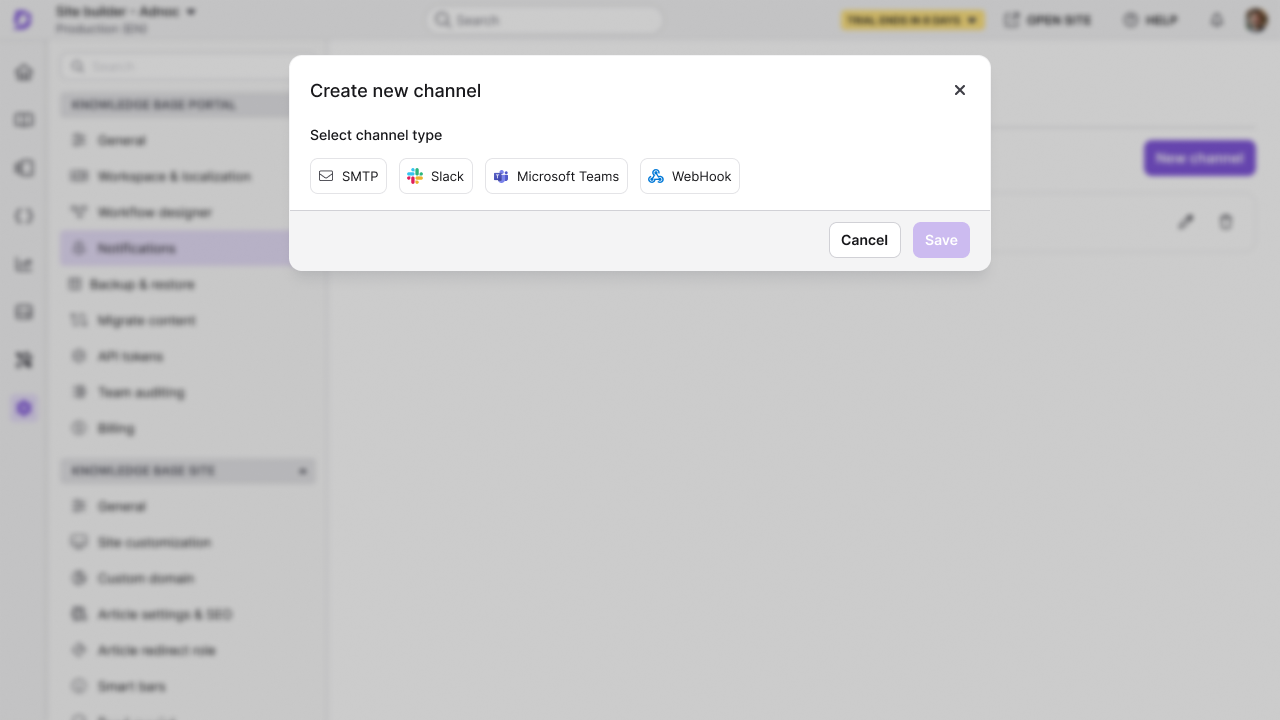
- Select Microsoft Teams.
Configure the channel options appears in the same panel once you click on the channel type. - Enter a name for this channel in the Friendly name field.
- In the Webhook URL field, paste the webhook URL copied from the Power Automate Workflow.
- Click Save.
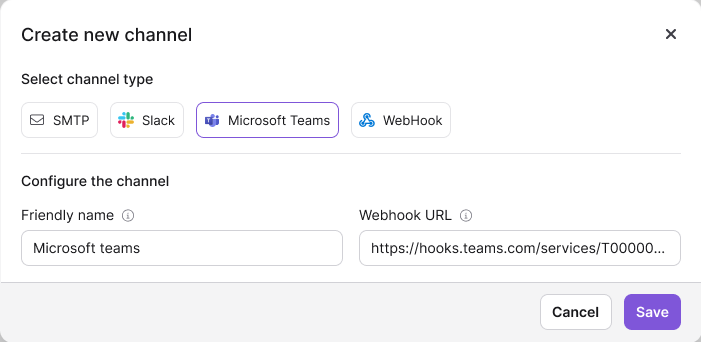
Your Microsoft Teams notification channel is now active. Go to the Notification mapping tab to control which events send notifications to this channel.
Migrating from Incoming Webhook to Power Automate Workflows
If you previously set up Microsoft Teams notifications in Document360 using the Incoming Webhook connector, you must migrate to Power Automate Workflows to ensure notifications continue to be delivered.
Step 1: Create a new Power Automate Workflow in Microsoft Teams
- In Microsoft Teams, navigate to the channel that was previously receiving Document360 notifications.
- Click the More options (⋯) icon next to the channel name.
- Select Workflows.
- In the Workflows panel, search for and select the template Post to a channel when a webhook request is received.
- Enter a name for your workflow, verify the connection account shown, and click Next.
- Confirm the Team and Channel, then click Create.
- Once the workflow is created, a unique webhook URL is generated.
- Click Copy to save the new webhook URL to your clipboard.
- Click Done.
Step 2: Update the webhook URL in Document360
- Navigate to Settings > Knowledge base portal > Notifications in the left navigation bar of the Knowledge base portal.
The Notification channels tab opens by default. - Locate your existing Microsoft Teams notification channel and click the Edit () icon.
- In the Webhook URL field, replace the old Incoming Webhook URL with the new Power Automate Workflow URL you copied.
- Click Save.
Your existing notification mappings remain intact. Notifications will now be delivered through the new Power Automate Workflow.
Once you have confirmed that notifications are working correctly through the new workflow, you can safely deactivate or delete the old Incoming Webhook connector from your Microsoft Teams channel settings.
Best practices
- Use a dedicated channel for Document360 notifications — Avoid posting notifications to a general chat channel. A dedicated channel keeps documentation updates visible and reduces noise.
- Name your webhook workflows clearly — When creating workflows in Power Automate, use descriptive names (for example, "Document360 – Prod KB Notifications") so they are easy to identify and manage later.
- Test before going live — After configuration, trigger a test event in Document360 to confirm notifications arrive correctly in Teams before announcing the channel to your team.
- Monitor workflow status in Power Automate — Periodically verify that your Power Automate Workflow is active, since disabled or expired workflows silently stop delivering notifications.
FAQ
How do I confirm that notifications are being sent to Microsoft Teams?
After setting up the Microsoft Teams notification channel, test it by mapping a sample notification or enabling a test article update. Check the Teams channel to verify that notifications are arriving as expected. If they aren't, double-check the webhook URL generated by the Power Automate Workflow and ensure the workflow is active in Power Automate.
What should I do if I get an authorization error in Teams?
Authorization errors often occur if the webhook URL is outdated or permissions are not configured correctly. Generate a new webhook URL in Microsoft Teams and update it in Document360. Ensure that the channel has the necessary permissions to receive notifications.
What should I do if notifications stop working after migration?
This may occur if the Power Automate Workflow is disabled, deleted, or if the webhook URL was not updated correctly in Document360. Go to Power Automate, verify the workflow is active, and if needed, recreate the workflow and update the new webhook URL in Document360 under Settings > Knowledge base portal > Notifications.
How do I deactivate notifications for specific events in Microsoft Teams?
Go to the Notification mapping tab in Document360 and unselect the event types you no longer wish to receive in Microsoft Teams. This allows you to manage notification frequency and relevance without removing the channel entirely.
Can I use different Teams channels for different types of notifications?
Yes. Create separate channels in Microsoft Teams, configure each with its own webhook URL in Document360, and then use Notification mapping to assign different event types to each channel.