Notification mapping in Document360 lets you connect specific portal events to notification channels such as email, Slack, or Microsoft Teams, so your team receives automatic alerts when content or settings change. Instead of manually checking for updates, you configure which events trigger alerts and which channels receive them, so contributors, reviewers, and admins stay informed. Notification mapping is available in the Knowledge base portal under Settings > Notifications > Notification mapping.
When to use notification mapping
Use notification mapping when you need to:
- Keep a distributed content team in sync: when multiple contributors work across articles and categories, mapping events like article published or workflow status updated ensures no one misses a change they need to act on.
- Maintain an audit trail for security changes: when your knowledge base has strict access controls, mapping events in the Users & security settings module (role changes, SSO updates, IP restrictions) gives admins an automatic record of every change without manual log reviews.
- Reduce review bottlenecks: when articles go through an approval workflow, mapping workflow assignee and due date events to a team channel keeps reviewers accountable and deadlines visible.
- Trigger external automation on workflow changes: map Article workflow status updated to a webhook channel (see Webhook notification channel) to notify or trigger downstream tools such as n8n, Make, or Zapier when an article moves through your documentation workflow.
Before you begin
- You must have Owner or Admin role permissions to configure notification mapping.
- At least one notification channel (SMTP, Slack, Microsoft Teams, or another supported channel) must be configured before you can map events to it. See Setting up notification channels for setup instructions.
All notification events are turned off by default. When you enable an event, you must assign at least one channel to it. Enabling a toggle without a mapped channel will not deliver notifications.
How to configure notification mapping
Enable and map notification events
-
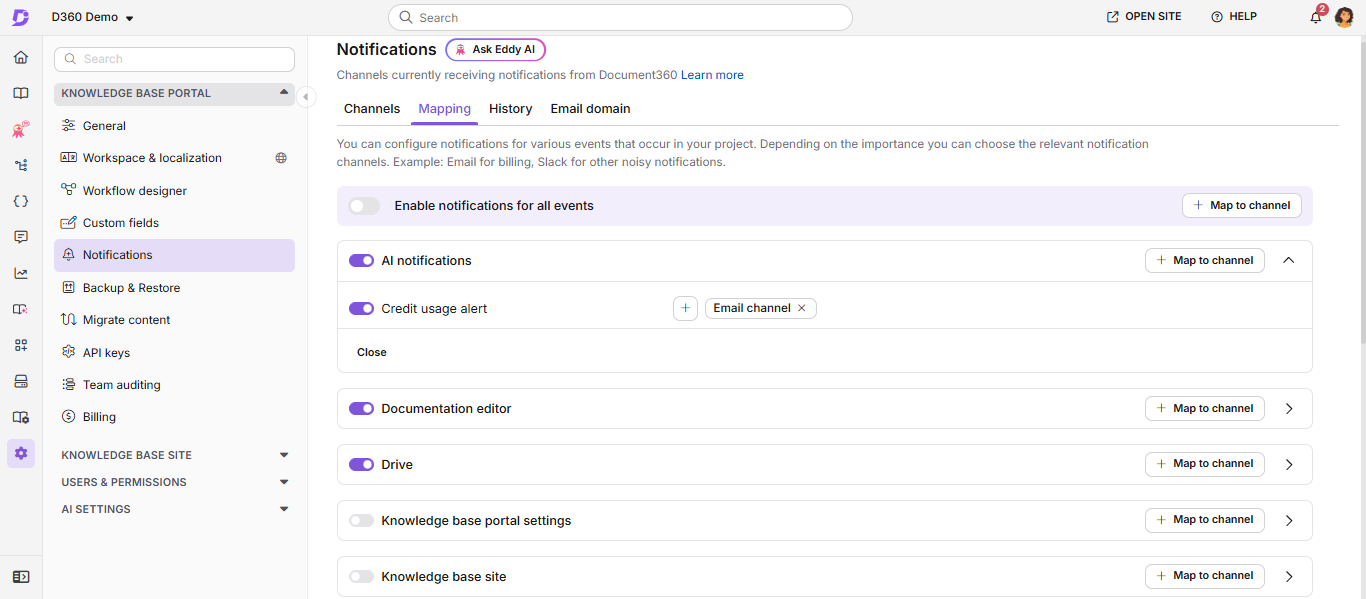
Navigate to Settings () > Knowledge base portal in the left navigation bar.
-
In the left navigation pane, select Notifications.
-
Click the Notification mapping tab.
-
To enable all events at once, turn on the All events toggle.
-
To enable a specific module only, turn on that module's toggle.
-
To enable individual events within a module, expand the module accordion and turn on each event toggle you need.
Example: Turn on the Documentation editor module toggle to receive all editor-related notifications. Alternatively, expand the module and enable only the Article published toggle to receive notifications for that specific event.
-
Click Map to channel to assign channels to events in bulk, or click the icon next to any individual event to assign a channel to that event alone.
Enable the analytics weekly report
Project owners can subscribe to a weekly analytics report delivered by email.
- Navigate to Settings () > Knowledge base portal in the left navigation bar.
- In the left navigation pane, select Notifications.
- Click the Notification mapping tab.
- Expand the Analytics accordion and turn on the Analytics weekly mail toggle.
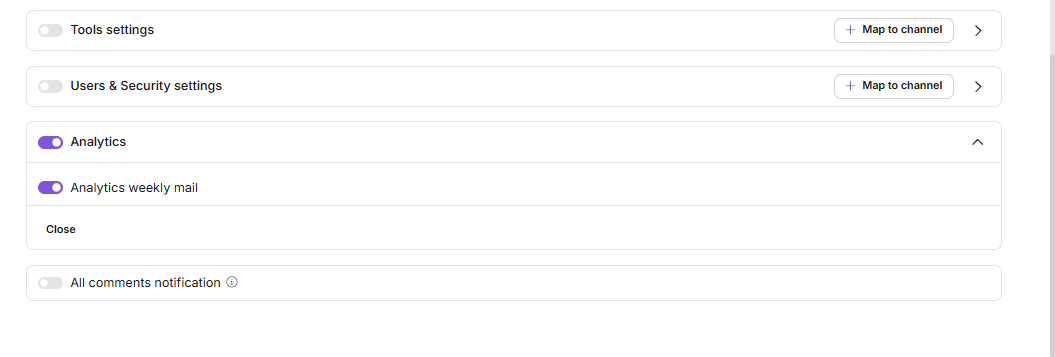
- The analytics weekly report email includes article views, reads, and likes from the Knowledge Base site for the project's main workspace and default language.
- Widget analytics and data from other workspaces or languages are not included in the weekly email, though they remain accessible in the Analytics section of the portal.
Notification events reference
The following modules list all available notification events. Expand each module to view its events.
Documentation editor
| Event | Function and use |
|---|---|
| Article visibility changed | Fires when an article's visibility settings are changed, affecting who can see it. |
| Article settings updated | Fires when article-level settings are modified. |
| Article slug updated | Fires when an article's URL slug changes, impacting how it is accessed. |
| Article title updated | Fires when an article's title changes. |
| Article published | Fires when an article is published and made available to readers. |
| Article created | Fires when a new article is created. |
| Article renamed | Fires when an article is renamed. |
| Article deleted | Fires when an article is deleted. |
| Article forked | Fires when an article is forked to create a new version based on the original. |
| Article version deleted | Fires when a specific version of an article is deleted. |
| Bulk delete article versions | Fires when multiple article versions are deleted at once. |
| Updated translation status | Fires when an article's translation status changes. |
| Articles reordered | Fires when the display order of articles changes. |
| Article contributors updated | Fires when the contributor list for an article changes. |
| Article workflow status updated | Fires when an article's workflow status changes. |
| Article workflow due date updated | Fires when the due date for an article workflow is changed. |
| Article workflow assignee updated | Fires when the assignee for an article workflow changes. |
| Category created | Fires when a new category is created. |
| Category type updated | Fires when a category's type is changed. |
| Category settings updated | Fires when category settings are modified. |
| Category slug changed | Fires when a category's URL slug is changed. |
| Category contributors updated | Fires when the contributor list for a category changes. |
| Category deleted | Fires when a category is deleted. |
| Category renamed | Fires when a category is renamed. |
| Categories reordered | Fires when the display order of categories changes. |
| Category published | Fires when a category is published. |
| Category forked | Fires when a category is forked. |
| Category version deleted | Fires when a specific version of a category is deleted. |
| Bulk delete category versions | Fires when multiple category versions are deleted at once. |
| Category workflow status updated | Fires when a category's workflow status changes. |
| Category workflow due date updated | Fires when the due date for a category workflow changes. |
| Category workflow assignee updated | Fires when the assignee for a category workflow changes. |
| Category visibility changed | Fires when a category's visibility settings are changed. |
| Article review reminder status updated | Fires when an article review reminder's status is updated. |
| Article pushed to Crowdin | Fires when an article is sent to Crowdin for translation. |
| Categories/Articles restored | Fires when deleted categories or articles are restored. |
| Categories/Articles permanently deleted | Fires when categories or articles are permanently removed. |
| Recycle bin emptied | Fires when the recycle bin is cleared. |
| Shared article created | Fires when a shared article is created. |
| Clone article created | Fires when an article is cloned. |
| Removed reference article | Fires when a reference article link is removed. |
| Multiple shared articles created | Fires when several shared articles are created at once. |
| Article publish later canceled | Fires when a scheduled article publish is canceled. |
| Article scheduled for publish | Fires when an article is scheduled for future publication. |
| Share link deleted | Fires when a private share link for an article is deleted. |
| Share link generated | Fires when a new private share link for an article is created. |
| Archived Categories/Articles | Fires when a category or article is archived and moved to the Archive page. |
| Unarchived Categories/Articles | Fires when an archived category or article is unarchived and returned to the documentation. |
| Permanently deleted an archived document | Fires when an archived category or article is permanently deleted from the Archive page. |
Drive
| Event | Function and use |
|---|---|
| Folder added | Fires when a new folder is created in Drive. |
| Folder renamed | Fires when a folder is renamed. |
| Folder deleted | Fires when a folder is deleted. |
| File(s) added | Fires when new files are uploaded. |
| File(s) updated | Fires when existing files are changed. |
| File(s) deleted | Fires when files are removed. |
Knowledge base portal settings
| Event | Function and use |
|---|---|
| Workspace updated | Fires when workspace settings are modified. |
| Workspace deleted | Fires when a workspace is deleted. |
| Workspace created | Fires when a new workspace is created. |
| Workspace display order changed | Fires when the display order of workspaces changes. |
| Plan tier changed | Fires when the subscription plan is upgraded or downgraded. |
| Payment details updated | Fires when billing information is updated. |
| Project general settings updated | Fires when general project settings are changed. |
| Backup created | Fires when a workspace backup is created. |
| Backup restored | Fires when a workspace backup is restored. |
| Notification channel deleted | Fires when a notification channel is deleted. |
| Notification channel created | Fires when a new notification channel is created. |
| Notification channel updated | Fires when a notification channel is modified. |
| Addons purchased | Fires when add-ons are purchased for a workspace. |
| Subscription created | Fires when a new subscription is created. |
| API token added | Fires when a new API token is added. |
| API token deleted | Fires when an API token is deleted. |
| Extension token generated | Fires when an extension token is created. |
| Extension token deleted | Fires when an extension token is deleted. |
| Crowdin token added | Fires when a Crowdin token is added. |
| Crowdin token deleted | Fires when a Crowdin token is removed. |
| Display workspaces as menu | Fires when workspaces are set to display as a menu. |
Knowledge base site settings
| Event | Function and use |
|---|---|
| Site design settings updated | Fires when site design settings are changed. |
| Custom JavaScript updated | Fires when custom JavaScript is updated. |
| Custom CSS updated | Fires when custom CSS is updated. |
| Article settings updated | Fires when site-level article settings are changed. |
| Project sub-domain updated | Fires when the project sub-domain changes. |
| Integration created | Fires when a new integration is established. |
| Integration deleted | Fires when an integration is removed. |
| Integration updated | Fires when an existing integration is modified. |
| Home page builder restored | Fires when the home page builder is restored to a previous version. |
| Home page builder settings updated | Fires when home page builder settings are changed. |
| Robots.txt updated | Fires when the robots.txt file is updated. |
| Site domain updated | Fires when the main site domain changes. |
| Cookie consent enabled | Fires when cookie consent is enabled. |
| Cookie consent disabled | Fires when cookie consent is turned off. |
| Cookie consent updated | Fires when cookie consent settings are modified. |
| Smart bar added | Fires when a smart bar is added to the site. |
| Smart bar updated | Fires when smart bar content or settings are changed. |
| Smart bar enabled | Fires when the smart bar is enabled. |
| Smart bar disabled | Fires when the smart bar is turned off. |
| Smart bar deleted | Fires when the smart bar is permanently removed. |
| Ticket deflector deleted | Fires when a ticket deflector is deleted. |
| Ticket deflector added | Fires when a new ticket deflector is added. |
| Ticket deflector updated | Fires when a ticket deflector is modified. |
| Ticket deflector helpdesk added | Fires when a helpdesk is added to a ticket deflector. |
| Ticket deflector helpdesk updated | Fires when helpdesk settings in a ticket deflector are updated. |
| Ticket deflector helpdesk deleted | Fires when a helpdesk is removed from a ticket deflector. |
| Article redirection rule added | Fires when a new article redirect rule is created. |
| Article redirect rule updated | Fires when an existing article redirect rule is modified. |
| Article redirection rule(s) deleted | Fires when article redirect rules are deleted. |
| Redirect rule(s) exported to CSV | Fires when redirect rules are exported to a CSV file. |
| Redirect rules import requested | Fires when a redirect rules import is requested. |
| Meta description generated | Fires when a meta description for an article is generated. |
| Meta details updated | Fires when meta details for articles are updated. |
| Knowledge base builder updated | Fires when the knowledge base builder is updated. |
| Knowledge base builder published | Fires when the knowledge base builder is published. |
| Read receipt rule created | Fires when a read receipt rule is created. |
| Read receipt rule updated | Fires when a read receipt rule is modified. |
| Read receipt rule deleted | Fires when a read receipt rule is deleted. |
Knowledge base widget settings
| Event | Function and use |
|---|---|
| Knowledge base widget settings updated | Fires when widget settings are changed. |
| URL mapping created | Fires when a new URL mapping is created. |
| URL mapping updated | Fires when a URL mapping is modified. |
| URL mapping deleted | Fires when a URL mapping is removed. |
| Knowledge base widget settings deleted | Fires when widget settings are deleted. |
| Knowledge base widget settings created | Fires when new widget settings are created. |
Users & security settings
| Event | Function and use |
|---|---|
| Site visibility changed | Fires when site visibility settings change. |
| Role added | Fires when a new user role is created. |
| Role updated | Fires when a role's permissions are modified. |
| Role deleted | Fires when a user role is removed. |
| Security group added | Fires when a new security group is created. |
| Security group updated | Fires when a security group's settings are changed. |
| Security group deleted | Fires when a security group is removed. |
| Content access added | Fires when new content access permissions are granted. |
| Reader access added | Fires when reader access is granted to users or groups. |
| Content access updated | Fires when content access permissions are modified. |
| Reader access updated | Fires when reader access permissions are changed. |
| Content access removed | Fires when content access permissions are revoked. |
| Reader access removed | Fires when reader access is revoked. |
| User added | Fires when a new user is created. |
| User updated | Fires when an existing user's details are modified. |
| User deleted | Fires when a user is removed. |
| IP restrictions updated | Fires when IP address restriction settings are modified. |
| IP restriction added | Fires when a new IP restriction is added. |
| IP restriction deleted | Fires when an IP restriction is removed. |
| Self sign-up settings updated | Fires when self-sign-up settings are changed. |
| Import readers requested | Fires when a reader import is requested. |
| Import user requested | Fires when a user import is initiated. |
| Export user(s) to CSV | Fires when user data is exported to CSV. |
| Export reader(s) to CSV | Fires when reader data is exported to CSV. |
| SSO configuration added | Fires when a new SSO configuration is created. |
| SSO configuration updated | Fires when an SSO configuration is modified. |
| SSO configuration deleted | Fires when an SSO configuration is removed. |
| SSO users invited | Fires when SSO invitations are sent to users. |
| JWT created | Fires when a new JSON Web Token is generated. |
| JWT regenerated | Fires when an existing JWT is regenerated. |
| JWT saved | Fires when a JWT is saved. |
| JWT updated | Fires when a JWT is modified. |
| JWT deleted | Fires when a JWT is removed. |
| Inheritance settings updated | Fires when permission inheritance settings are modified. |
| Convert to reader | Fires when a user account is converted to a reader. |
| Convert to SSO user | Fires when a user is converted to an SSO user. |
| Convert to SSO reader | Fires when a user is converted to an SSO reader. |
| Convert to user | Fires when a reader or SSO user is converted to a standard user. |
Tools settings
| Event | Function and use |
|---|---|
| Project exported | Fires when a project is successfully exported. |
| Project imported | Fires when a project is successfully imported. |
| External project import requested | Fires when an external project import is requested. |
| Export PDF requested | Fires when a PDF export is initiated. |
| Export PDF content template added | Fires when a new PDF content template is added. |
| Export PDF content template updated | Fires when a PDF content template is modified. |
| Export PDF content template deleted | Fires when a PDF content template is removed. |
| Export PDF design template added | Fires when a new PDF design template is created. |
| Export PDF design template deleted | Fires when a PDF design template is deleted. |
| Export PDF design template updated | Fires when a PDF design template is changed. |
| Article review reminder created | Fires when an article review reminder is set. |
| Article review reminder updated | Fires when an article review reminder is changed. |
| Article review reminder deleted | Fires when an article review reminder is removed. |
| Content reuse variable added | Fires when a new content reuse variable is created. |
| Content reuse variable updated | Fires when a content reuse variable is modified. |
| Content reuse variable deleted | Fires when a content reuse variable is removed. |
| Content reuse snippet added | Fires when a new content reuse snippet is created. |
| Content reuse snippet updated | Fires when a content reuse snippet is modified. |
| Content reuse snippet deleted | Fires when a content reuse snippet is removed. |
| Article template added | Fires when a new article template is created. |
| Article template updated | Fires when an article template is modified. |
| Article template deleted | Fires when an article template is removed. |
| Tag added | Fires when a new tag is created. |
| Tag updated | Fires when a tag is modified. |
| Tag deleted | Fires when a tag is removed. |
| Article imported | Fires when an article is successfully imported. |
| Workflow status added | Fires when a new workflow status is created. |
| Workflow status updated | Fires when a workflow status is modified. |
| Workflow status deleted | Fires when a workflow status is removed. |
| Workflow status reordered | Fires when workflow statuses are reordered. |
| Update feedback assignee | Fires when feedback is reassigned to a different team member. |
| Update feedback status | Fires when the status of feedback changes. |
| Find and replace | Fires when the find-and-replace function is executed. |
| Content reuse glossary suggested | Fires when a content reuse glossary suggestion is made. |
| Export PDF password removed | Fires when password protection is removed from an exported PDF. |
Knowledge base site
| Event | Function and use |
|---|---|
| Feedback received | Fires when a reader submits written feedback on an article. Feedback on Eddy AI responses is not included. |
| Reader email updated | Fires when a reader's email address is changed. |
| Reader self-registration | Fires when a new reader self-registers. |
| Like received | Fires when an article receives a like. |
| Dislike received | Fires when an article receives a dislike. |
AI notifications
| Event | Function and use |
|---|---|
| Credit usage alert | Fires when Eddy AI credits fall to 20%, 10%, or expire entirely. |
Analytics
| Event | Function and use |
|---|---|
| Analytics weekly metrics | Fires when the weekly analytics report is ready for the project. |
All comments notification
| Event | Function and use |
|---|---|
| All comments notifications | Alerts contributors when inline comments are added to articles they have contributed to. |
Best practices
- Enable events selectively: turning on all events can create notification fatigue. Enable only the events that require immediate action from your team.
- Map critical security events first: prioritise events in the Users & security settings module (role changes, SSO updates, IP restrictions) to maintain an audit trail.
- Use dedicated channels per module: map documentation events to a content team channel and security events to an admin channel to reduce noise.
- Re-map events immediately when a channel is deleted: if a notification channel is removed, any events mapped to it silently stop delivering. Check and reassign affected events as soon as a channel is deleted.
- Verify delivery using notification history: after mapping an event to a channel, use the Notification history tab to confirm that notifications for that event are being delivered. This is useful when troubleshooting reports that an expected notification, such as Article created, was not received.
FAQ
How do I get notified in Microsoft Teams whenever articles are published?
Navigate to Settings > Knowledge base portal > Notifications > Notification mapping. Expand the Documentation editor accordion, enable the Article published toggle, and click the icon to assign Microsoft Teams as the channel. See Microsoft Teams notification channel for setup instructions.
How do I get notified when my project is exported to Slack?
Navigate to Settings > Knowledge base portal > Notifications > Notification mapping. Expand the Tools settings accordion, enable the Project exported toggle, and assign Slack as the channel. See Slack notification channel for setup instructions.
How do I get notified when a new user is added via email?
Navigate to Settings > Knowledge base portal > Notifications > Notification mapping. Expand the Users & Security settings accordion, enable the User added toggle, and assign your SMTP channel. See SMTP notification channel for setup instructions.
How do I get notified when Eddy AI credit usage is low?
Navigate to Settings > Knowledge base portal > Notifications > Notification mapping. In the AI notifications accordion, enable the Credit usage alert toggle. Document360 will then notify your configured channels when the credit balance reaches 20%, 10%, or expires.
How can contributors be notified of inline comments on articles?
Navigate to Settings > Knowledge base portal > Notifications > Notification mapping and enable the All comments notification toggle. Contributors will then receive email notifications whenever inline comments are added to articles they have contributed to.
Why am I not receiving email notifications when a new article is created?
Verify that the Article created toggle is enabled under Notification mapping > Documentation editor, and that at least one email channel is mapped to it. Note that articles created via the Word import feature do not trigger the Article created notification event.
Can I receive notifications when a reader leaves feedback on the knowledge base site?
Yes. Navigate to Notification mapping > Knowledge base site and enable the Feedback received, Like received, and/or Dislike received toggles as needed. Note that feedback on Eddy AI responses does not trigger a notification. Monitor that manually in the Feedback manager.