The Users & groups — Full portal search page is a dedicated search interface within Document360 that lets you find users, user groups, readers, and reader groups across your knowledge base project from a single location. Instead of navigating to separate management pages, you can search by name and instantly view role details, login activity, and access permissions — then jump directly to the relevant management page from the results.
When to use the Users & groups portal search
- Quickly locate a specific user or group without scrolling through full lists
- Check the portal role or content role of a team member
- Audit inactive team members or readers before a permission review
How to search users and groups in the full portal
Open the Users & groups search
- Click the Search () field in the top navigation bar.
Press the Escape key to close the search screen.
-
From the Search all dropdown on the left of the search bar, select Users & Groups.
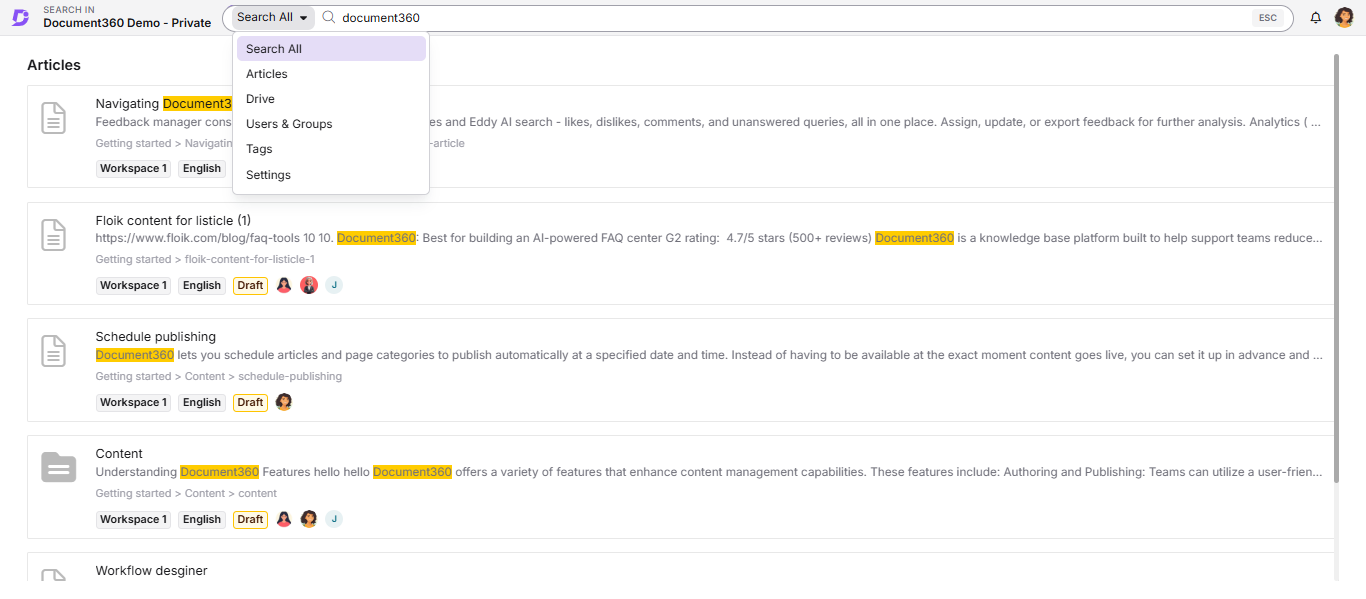
-
Type your search keyword in the search bar.
The results appear under two tabs: Users & groups and Readers & groups.
Work with Users & groups results
The Users & groups tab displays the name, portal role, and login activity for each matching user or group.
User
- Click the desired user to open the View access permissions panel, which shows the portal role and content role.
- Click Manage permissions at the top of the panel to open the User management page.
User groups
- Click the desired user group to open the View access permissions panel, which shows the portal role and content role.
- Click View associated team members to open the User group page.
Work with Readers & groups results
The Readers & groups tab displays the name and login activity for each matching reader or reader group.
Readers
- Click the desired reader to navigate to the Readers page.
Reader groups
- Click View associated readers to view and manage the readers in the group and their content access.
Filters
Use filters to narrow your search results after entering a keyword.
Type
Filter by the entity type. The available options are:
| Option | Description |
|---|---|
| All entity | Displays all users, user groups, readers, and reader groups (default) |
| User | Displays only individual users |
| User groups | Displays only user groups |
| Reader | Displays only readers |
| Reader Groups | Displays only reader groups |
Last logged in
Filter by the last login date. The available options are:
| Option | Description |
|---|---|
| All | No login date filter applied (default) |
| 7 days | Logged in within the last 7 days |
| 30 days | Logged in within the last 30 days |
| 3 months | Logged in within the last 3 months |
| 1 year | Logged in within the last year |
| Custom date | Specify a custom date range |
After selecting your filters, click Apply. To reset all filters and return to unfiltered results, click Clear.
Best practices
- Use the Type filter before searching to narrow results when you know whether you're looking for a user, group, or reader — this reduces noise in large projects.
- Use the Last logged in filter to identify inactive users or readers who may need access reviewed or revoked.
- After opening the View access permissions panel, use Manage permissions (for users) or View associated team members (for user groups) to make changes without losing your search context.
FAQ
What is the difference between the Users & groups tab and the Readers & groups tab?
The Users & groups tab shows portal contributors — people who create or manage content — along with their portal role and content role. The Readers & groups tab shows external readers who consume the knowledge base, along with their login activity.
Can I edit user permissions directly from the search results?
You cannot edit permissions inline from the search results. Click the user to open the View access permissions panel, then click Manage permissions to open the full User management page where changes can be made.