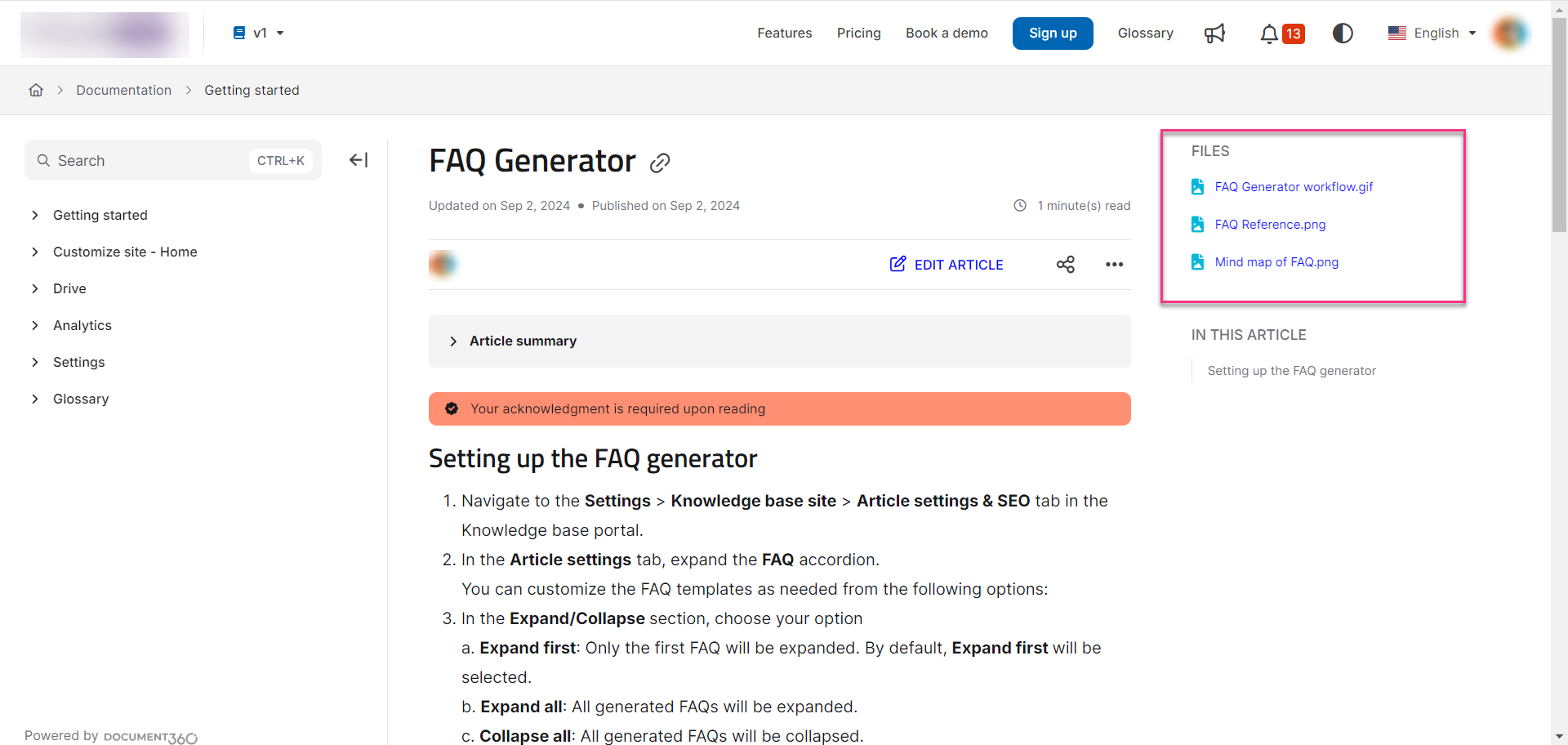
Attachments let you add downloadable files to an article so readers can access supporting documents, templates, or reference materials directly from the knowledge base site. Attachments appear near the table of contents and tags section on the article page.
When to use attachments
Add attachments to an article when:
- The article references a file that readers need to download, for example a CSV template, a configuration file, or a sample document.
- The supporting material is too long or complex to include as inline article content.
- You want to provide a printable or offline version of content alongside the online article.
Add attachments to an article
- Navigate to any article in the knowledge base portal.
- Click the More () icon in the article header and select More article options.
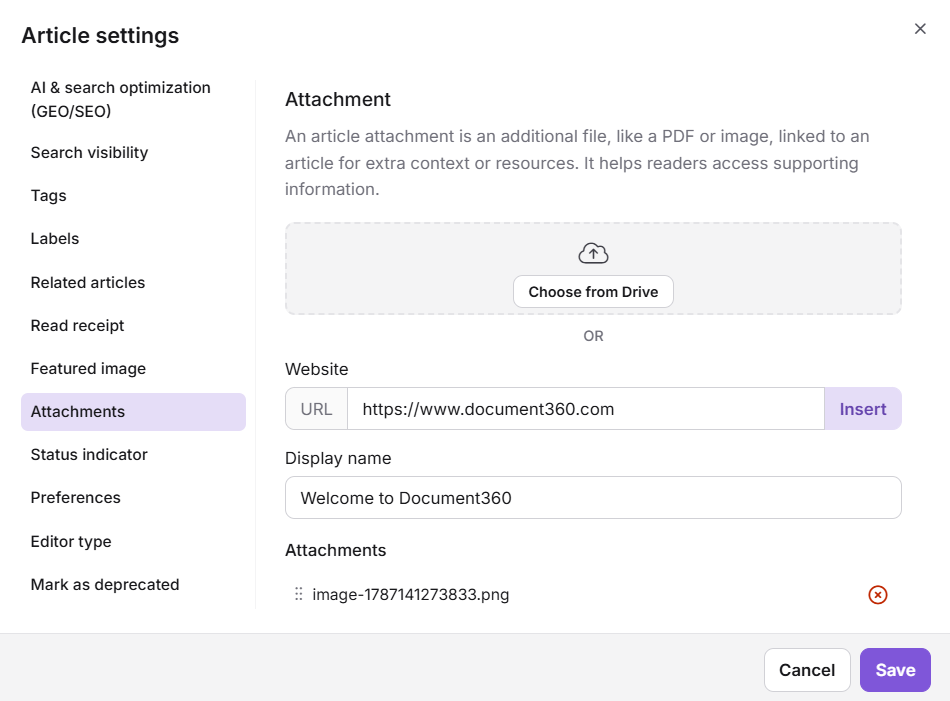
- In the Article settings panel, select the Attachments tab.
- Add the file in one of two ways:
- Enter the file URL & Display name in the provided fields if the file is hosted externally.
- Click Choose from Drive to select a file from Drive.
- Select the file and click Insert.
- Repeat steps 4 and 5 to add multiple attachments.
- To reorder attachments, drag them using the Reorder () icon.
- To remove an attachment, click the () icon next to it.
- Click Save.
Attachments appear near the table of contents and tags section on the knowledge base site.
Limitations
| Item | Detail |
|---|---|
| Maximum file size (single file) | 150 MB. |
| Maximum combined size (multiple files) | 160 MB. |
| Supported sources | Drive or external URL. |
| External URL attachments | Link will break if the external file is moved or deleted. |
Best practices
- Use descriptive file names. Name files so readers immediately understand what they are downloading, for example
import-template-v2.csvis clearer thantemplate.csv. - Host files in Drive when possible. Drive-hosted files ensure attachment links remain stable. If you use an external URL and the file moves or is deleted, the attachment link will break.
- Keep attachments current. Review attachments when updating an article to ensure referenced files are up to date and links are not broken.
- Use attachments for supplementary content only. Keep the core information in the article body. Attachments work best for files readers need to download and use, not for content they need to read in order to understand the article.