At Document360, we believe you should know exactly how Eddy AI handles your data. This section covers everything from compliance certifications to how your data flows to Azure OpenAI and back.
Compliance
Eddy AI follows these industry standards:
| Standard | What it means |
|---|---|
| GDPR | Data protection and privacy rights for all EU users. |
| SOC 2 Type II | Independent audit confirming our security, availability, and confidentiality controls. Also aligned with EU AI Act requirements. |
| NIST AI RMF | A voluntary framework that guides trustworthy AI design, development, and evaluation across the AI lifecycle. |
Subprocessors
Eddy AI uses the following trusted third-party services to deliver its features:
| Subprocessor | Role |
|---|---|
| MongoDB | Vector database for storing text embeddings and performing semantic-search reranking using Voyage AI models. |
| Microsoft Azure OpenAI | OpenAI models for generating Eddy AI responses (GPT-5.6 Luna), the AI glossary generator, the AI writing agent, and text embeddings |
| Azure | Cloud infrastructure (EU region) |
| Stripe | Payment processing |
| Segment | Product analytics |
| Mixpanel | Advanced usage analytics |
Data residency
Eddy AI uses Microsoft's Azure OpenAI Service and MongoDB to deliver its AI-powered features. Where your AI requests are processed depends on the region your project is hosted in.
| Hosting region | Where AI requests are processed |
|---|---|
| EU | Azure OpenAI requests are processed within the EU. Voyage AI reranking runs within the MongoDB EU cluster. |
| US | Azure OpenAI uses the US Data Zone deployment. Voyage AI reranking runs within the MongoDB US cluster. |
| Canada | Azure OpenAI requests are processed outside Canada, as the required models are not yet available in the Azure Canada region. |
Every Eddy AI feature, including the AI glossary generator and AI writing agent, follows the table above. In all regions:
- Text embeddings: Azure OpenAI generates text embeddings.
- Semantic search reranking: Eddy AI uses Voyage AI's
rerank-2.5-litemodel through MongoDB's native data-layer integration. Reranking is performed within the MongoDB cluster corresponding to your project's hosting region.
Data Security and Privacy
All data associated with Eddy AI is encrypted and protected.
- Data at rest: Encrypted using AES-256 bit symmetric encryption.
- Data in transit: Protected using HTTPS with TLS 1.2 (TLS 1.3 required for all Azure OpenAI {{ glossary.API}} calls).
- Prompts: Encrypted before storage.
- AI responses: Encrypted both in transit and at rest.
- Vector database: Field-level encryption applied to all embeddings stored in MongoDB.
- Passwords: Hashed using Bcrypt, PBKDF2, scrypt, or Argon2 with a unique cryptographic salt and pepper.
- Third-party connections: Certificate pinning enforced for Azure OpenAI endpoints. Mutual TLS required for high-sensitivity deployments.
Eddy AI is built for high availability with a 99.9% uptime SLA, backed by all subprocessors and third-party providers.
Document360 also maintains a formal AI incident response plan. See the AI Security Policies article for full details.
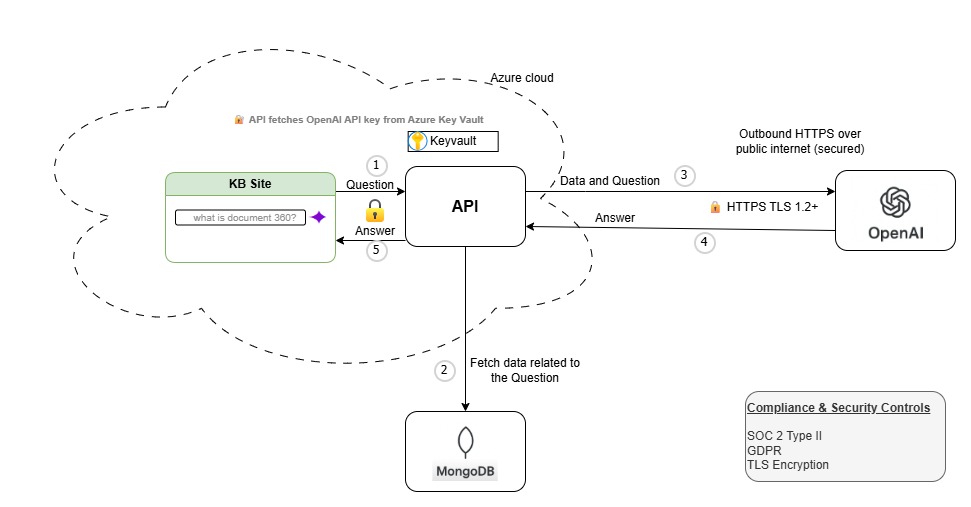
Eddy AI Data Flow and Secure Connection to Azure OpenAI
The diagram below shows how your queries travel from the Document360 UI, through the MongoDB vector store, to the Azure OpenAI {{ glossary.API}}, and back to you as a grounded, filtered response.
At every step, credentials are retrieved from Azure Key Vault. No raw API keys are stored in application code. The response is filtered before it reaches the end user.
Data Privacy
All Eddy AI features use OpenAI models through Microsoft's Azure OpenAI Service, and Eddy AI responses are generated using the GPT-5.6 Luna model. Under Microsoft's terms, your prompts and the generated responses:
- Are not available to OpenAI or to other customers.
- Are not used to train OpenAI models or to improve Microsoft or third-party products.
For full details, read Microsoft's Data, privacy, and security for Azure OpenAI Service.
FAQ
What countries and regions are these AI technologies/platforms/models hosted?
Eddy AI runs on Microsoft's Azure OpenAI Service, and where requests are processed depends on where your project is hosted. For EU-hosted projects, requests are processed within the EU. US-hosted projects use the Azure OpenAI US Data Zone deployment. For Canada-hosted projects, requests are processed outside Canada because the required models are not yet available in that region.
Voyage AI reranking runs within the MongoDB cluster for your project's hosting region. For details, see the Data residency section above.
Is Eddy AI built on the same infrastructure as Document360?
Yes, Eddy AI runs on the same secure and reliable infrastructure as Document360. This ensures consistent performance and compliance with our standards.
What is the uptime SLA, and is it supported by all subprocessors and third parties?
Document360 maintains a 99.9% uptime SLA, which is fully supported by all relevant subprocessors and third-party service providers involved in delivering our services.
Can we choose not to train third-party AI/LLMs on our data?
Yes, customer data is not used to train AI/LLM models. Eddy AI uses OpenAI models through Microsoft's Azure OpenAI Service. Under Microsoft's terms, your prompts and responses are not shared with OpenAI and are not used to train OpenAI models.
Does Document360 involve any generative AI or large language model (LLM) features?
Yes, Eddy AI, a feature in Document360, uses third-party LLMs from OpenAI, accessed through Microsoft's Azure OpenAI Service, and generative AI to enhance the user experience. It leverages advanced language models to provide smart assistance and content generation.