Block inheritance for readers controls who can read your published knowledge base. When you block inheritance for readers at any content level, only the readers or reader groups you explicitly add will be able to see that content on the knowledge base site.
Blocking inheritance for readers has no effect on user (portal) access, and vice versa. They are fully independent.
After migrating to inherited permissions, readers and reader groups automatically gain inherited access to all content below the level they were granted access to. Use block inheritance to stop this at a specific workspace, language, category, or article level.
When to use this
- A workspace contains content accessible to all readers, but one category should be visible only to a specific customer group.
- You need to isolate a language so that only readers from a specific region can access it.
- You want to reset accumulated inherited reader permissions and start fresh with an explicit list.
WARNING
Blocking inheritance is immediate. Inherited and future readers will not have access to the selected content level as soon as the toggle is enabled.
Before you begin
- You must have the Owner or Admin portal role.
- Your project's reader access must be set to Private or Mixed for reader access controls to apply.
- The user performing the block is automatically included in the access list and cannot be removed.
Block content access at workspace or language level
To block access to readers or reader groups at the workspace or language level:
- Navigate to Settings () > Users and security in the left navigation bar in the knowledge base portal.
- In the left navigation pane, navigate to Reader access.
- Select the required workspace and language from the tree-view on the left.
- Turn on the Block inherited access toggle in the Manage content access tab.
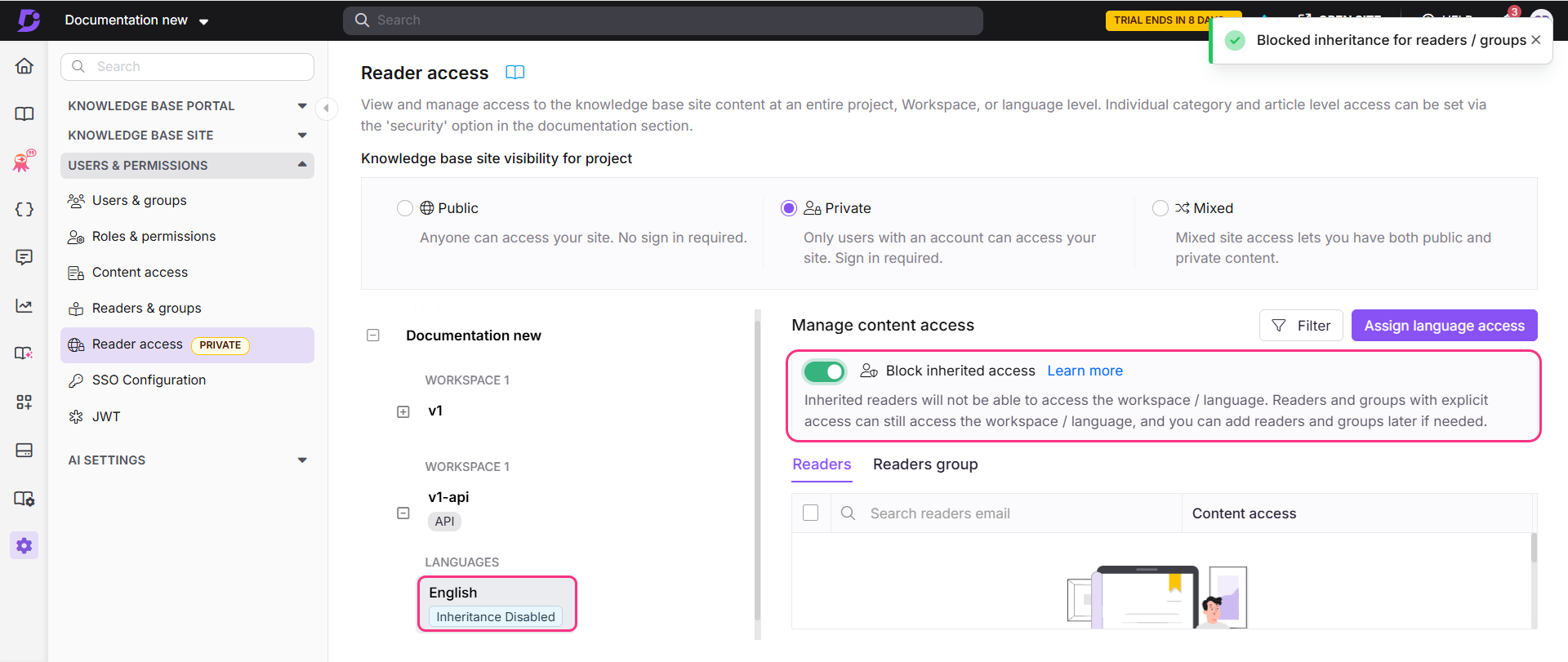
Inherited and future readers will not have access to this workspace or language. You can add readers or reader groups explicitly to grant access. See Reader access.
- To restore inherited access, turn off the Block inherited access toggle.
Block content access at category or article level
To block access to readers or reader groups for a category or article:
- Navigate to Documentation () and hover over the desired category or article in the Categories & Articles pane.
- Click the More () icon that appears next to the category or article name.
- Click Security, then choose Knowledge base Reader access control to manage content access for readers and reader groups.
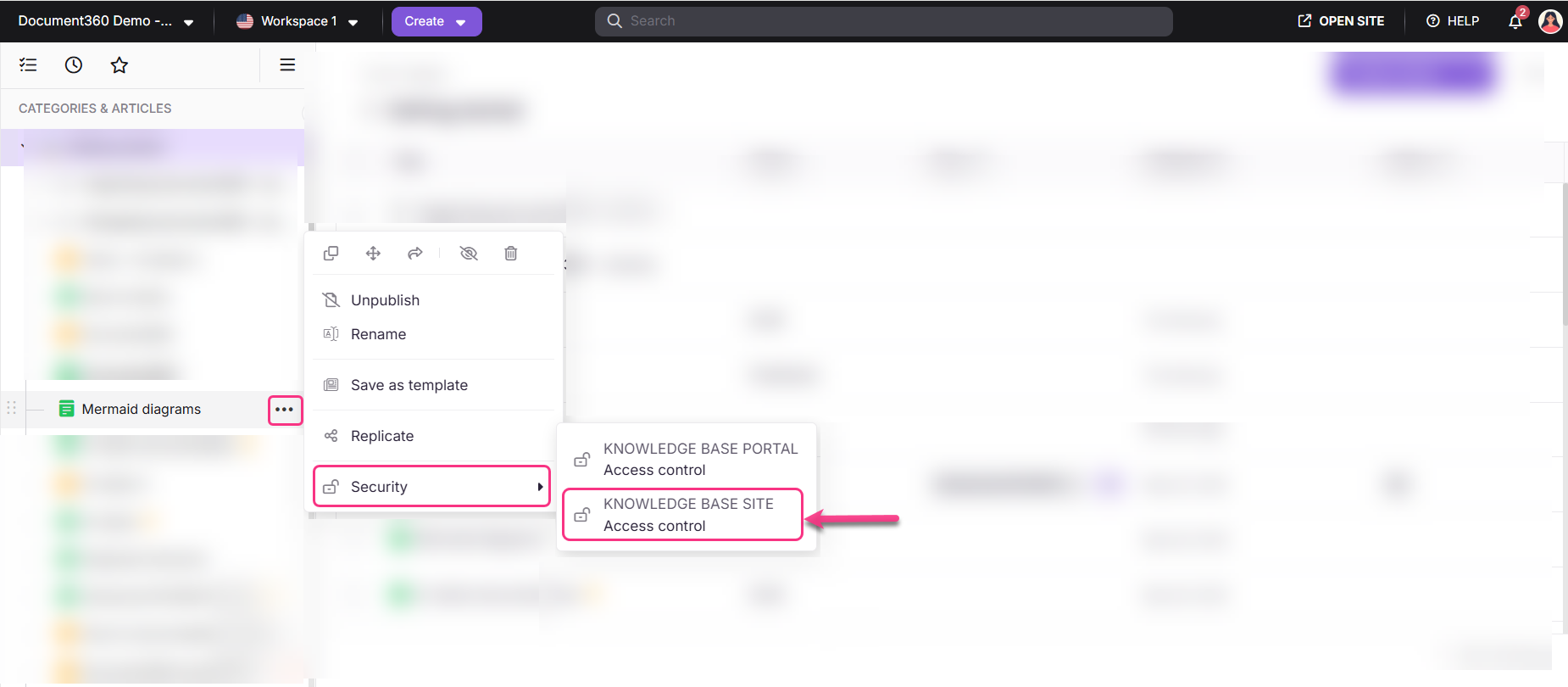
- The Assign control access: Knowledge base site panel appears with the list of readers and reader groups that have access to the selected content level.
- Turn on the Block inherited access toggle, then click Save.
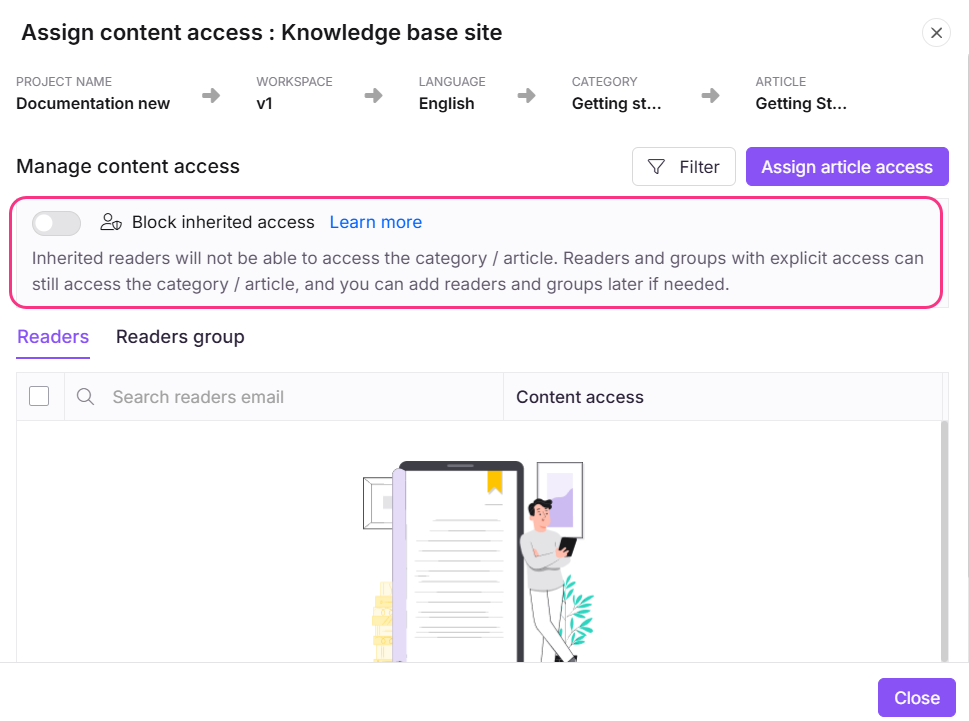
This filters out all inherited accounts, so only readers and reader groups with explicit access at this level are displayed. By default, the user performing this action is selected and cannot be removed.
- To restore inherited access, turn off the Block inherited access toggle and click Yes in the Allow inheritance confirmation prompt.
Considerations
| Item | Detail |
|---|---|
| Immediate effect | Blocking takes effect immediately — all inherited readers lose access at that level and below |
| Performer is always included | The user who performs the block is automatically added to the access list and cannot be removed |
| Project reader access type | Reader access controls only apply when the project is set to Private or Mixed |
| Independence from user access | Blocking reader inheritance never affects user (portal) access, and vice versa |
Best practices
- After blocking, explicitly add all readers and reader groups who need access before the change goes live. Readers who lose access will be unable to view that content on the site immediately.
- Use workspace-level blocking when you need to restrict an entire workspace from a reader audience. Use category or article-level blocking for targeted restrictions within an otherwise accessible workspace.
- When you want to stop all inherited access to a workspace permanently, block at the workspace level rather than blocking individual categories — this is simpler to manage over time.