The Import readers feature lets you add more than five readers to your Document360 project in a single operation using a CSV file. You can import up to 500 readers at a time, with optional SSO configuration, content access, and group assignment applied to all imported accounts at once.
When to import readers
- You are onboarding a large number of readers at once (for example, after a product launch or company-wide rollout).
- You need to add more than 5 readers and want to avoid creating them one by one.
- You have a prepared list of reader email addresses, first names, and last names ready in a spreadsheet.
Before you begin
- Your project's reader access must be set to Private or Mixed.
- You must have the Admin or Owner portal role, or a custom role with Manage user permission.
- Prepare a CSV file using the Document360 template (downloaded during the import flow). Do not modify the column headers.
- If you are importing SSO readers, have the SSO configuration name ready.
- If you want to add the imported readers to a reader group, create the group first. See Create reader group.
How to import readers
- Navigate to Settings () > Users and security in the left navigation bar of the knowledge base portal.
- In the left navigation pane, navigate to Readers & groups > Readers.
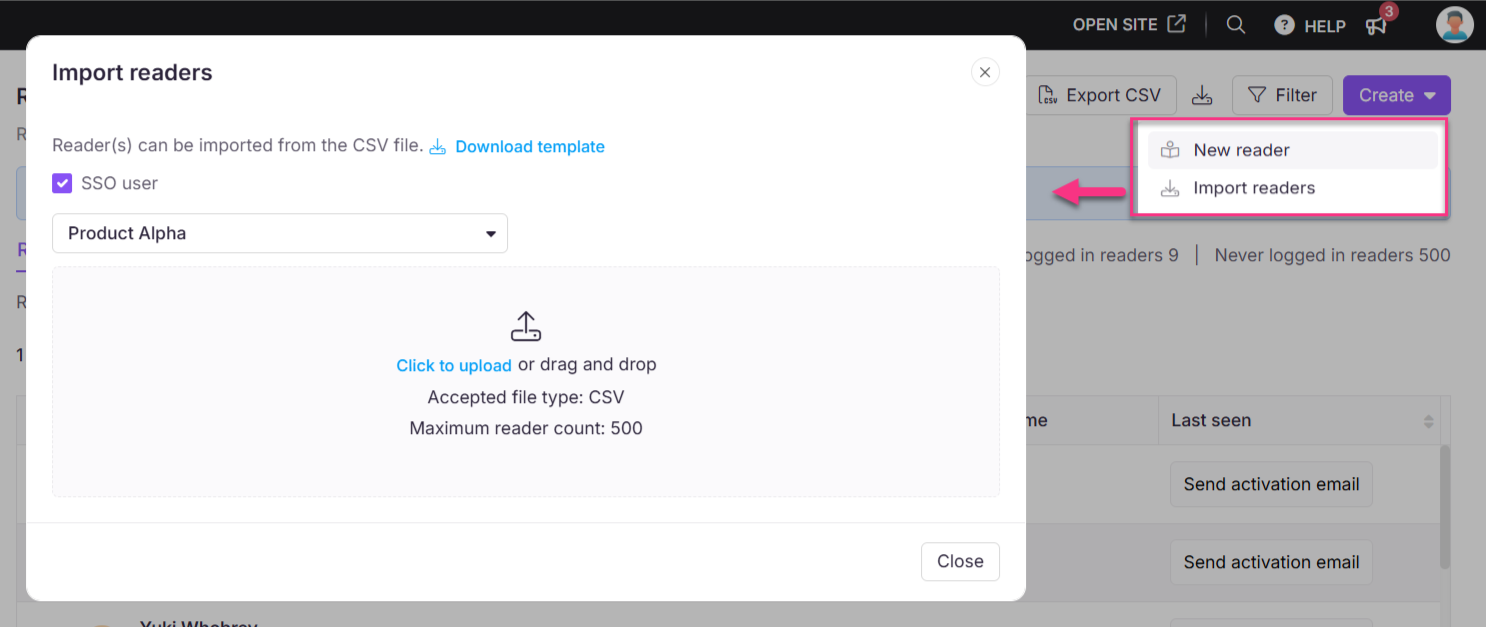
- Click the Create dropdown at the top right and choose Import readers to open the Import reader panel.
- Select the SSO user checkbox to add the imported readers as SSO users.
- If you selected the SSO user checkbox, select an SSO configuration from the Select SSO dropdown menu.
- Download the CSV file template by clicking the Download template option.
- Open the downloaded CSV file in a local application (such as Microsoft Excel) and enter the new account emails and first and last names. The template contains only the Email, FirstName, and LastName columns.
- Save the file and upload it in the Document360 panel by clicking Click to upload. You can also drag and drop the file into the designated drop frame.
- The data will be validated, and the Valid emails and Invalid emails will be listed in the Validation summary table.
- Click Skip invitation mail if you don't want your new readers to receive an invitation email.
- Assign the Content access for the imported readers. Optionally, select an existing reader group in the Group dropdown.
- Click Import.
Limits and limitations
| Limit | Detail |
|---|---|
| Maximum readers per import | 500 |
| File format | CSV only. Use the Document360 template — custom formats are not supported. |
| Content access assignment | A single content access level is applied to all imported readers. Edit individual readers after import if different access levels are needed. |
| Group assignment | Optional. A single existing group applies to all imported readers during import. You cannot create reader groups through the import. |
| SSO configuration | A single SSO configuration applies to all readers in the import batch. |
| Invalid emails | Rows with invalid or duplicate email addresses are skipped. Valid rows are still imported. |
Best practices
- Always use the downloaded CSV template. Uploading a file with different column headers or formatting will cause validation errors.
- Review the validation summary before confirming the import. Fix invalid rows in the CSV and re-upload if you need all readers to be created in a single batch.
- If you need to import readers with different content access levels or SSO configurations, split them across multiple import operations.
- Use Skip invitation mail only when you plan to notify readers through another channel — readers cannot log in until they receive their invitation or are added via SSO.
FAQ
What happens to invalid emails in the CSV?
Invalid or duplicate emails are listed in the Validation summary as Invalid emails and are skipped. All valid emails in the same file are still imported.
Can I assign different content access levels to different readers in the same import?
No. Content access is applied uniformly to all readers in a single import. Import in separate batches or edit individual readers after import to assign different levels.
Can I re-import the same CSV to add readers I missed?
Yes. Duplicate email addresses are detected during validation and skipped, so re-uploading a CSV that includes previously imported readers will not create duplicates.