Article preferences let you control per-article display and interaction options from the knowledge base portal. Settings are split into two groups: options that affect the editor experience in the portal, and options that affect how the article appears and behaves on the knowledge base site.
When to use preferences
Adjust article preferences when you need to enable or disable specific display or interaction options for a particular article without changing the global project settings. For example, you might hide the table of contents on a short article where it adds no navigation value, or disable comments on articles in a specific section.
Update preferences for an article
- Navigate to any article in the knowledge base portal.
- Click the More () icon in the article header and select More article options.
- In the Article settings panel, select the Preferences tab.
- Select or clear the checkbox next to each option as needed.
- Click Save.
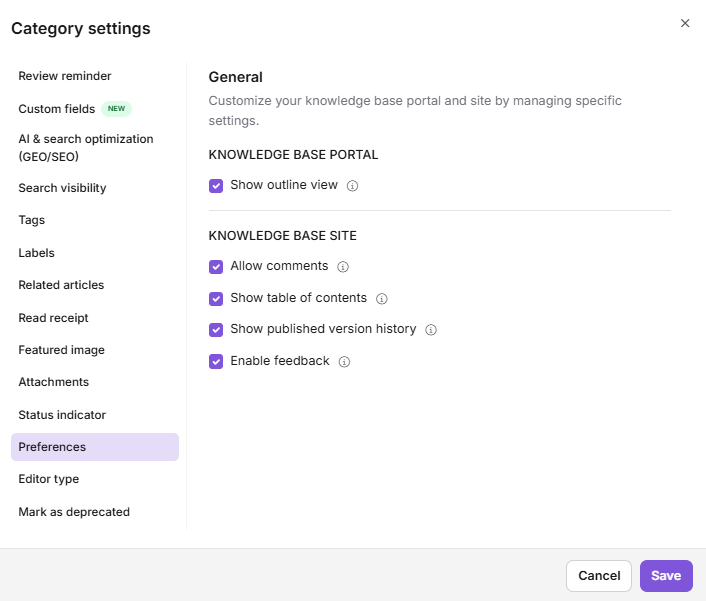
These preferences are also available from the Publish confirmation dialog. Click Publish (or Publish later), then select Preferences from the panel list on the left (under More) to make the same changes before publishing.
Preferences reference
Knowledge base portal
| Preference | Description |
|---|---|
| Show outline view | Displays the outline view in the editor, giving writers a structural overview of headings while editing. |
Knowledge base site
| Preference | Description |
|---|---|
| Allow comments | Allows readers to leave public comments on the article via Disqus. Requires the Disqus integration to be configured at the project level. Once Disqus is configured, commenting is enabled on all articles by default. |
| Show table of contents | Displays the article's table of contents on the knowledge base site. |
| Show published version history | Controls whether the published version history is visible on the knowledge base site for this article. Inherits the project-level setting by default. Users with edit access can turn this off per article. |
| Enable feedback | Shows the "Was this article helpful?" Yes/No widget at the bottom of the article. When a reader clicks Yes or No, a Leave a feedback dialog opens for them to submit written feedback. |
Allow comments and Enable feedback are two distinct options. Allow comments enables a Disqus-powered public comment thread. Enable feedback enables the "Was this article helpful?" widget and feedback dialog. Both can be enabled or disabled independently per article.
The knowledge base site preferences give you per-article control over three reader-facing features:
Allow public comments
Allow readers to leave public comments on articles via Disqus. Requires the Disqus integration to be configured.
Learn more →Show table of contents
Show or hide the table of contents site-wide or for a specific article.
Learn more →Show published version history
Show or hide the published version log on the knowledge base site for a specific article.
Learn more →Enable reader feedback
Show the "Was this article helpful?" widget so readers can rate articles and submit written feedback.
Learn more →Enable public comments
Document360 uses Disqus to allow readers to leave public comments on articles on the knowledge base site. The Allow comments checkbox in the Preferences tab controls this per article.
The Disqus integration must be configured at the project level before public comments can be enabled on any article. Once configured, commenting is enabled on all articles by default. Learn about Disqus integration →
To disable comments on a specific article:
- Navigate to the article in the knowledge base portal.
- Click the More () icon in the article header and select More article options.
- In the Article settings panel, select the Preferences tab.
- Clear the Allow comments checkbox.
- Click Save.
To re-enable comments, select the Allow comments checkbox and click Save.
Removing the Disqus integration turns off commenting on all articles. If you re-enable Disqus later, you will need to reconfigure the integration.
Show or hide the table of contents
The table of contents can be controlled at two levels: site-wide for all articles, or per article.
All articles
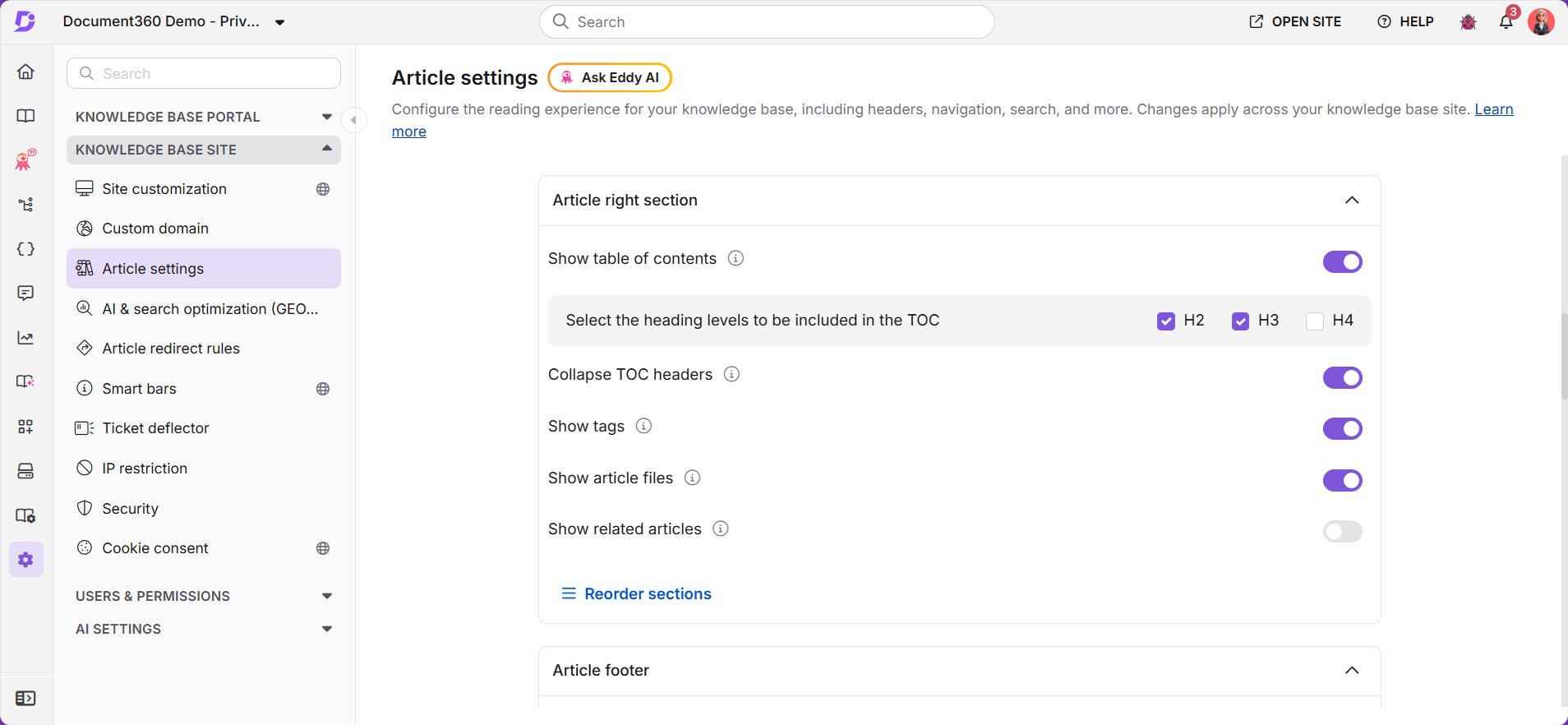
- Navigate to Settings () > Knowledge base site in the left navigation bar.
- Select Article settings in the left navigation pane.
- Scroll to the Article right section accordion.
- Turn the Show table of contents toggle on or off.
Changes save automatically.
Single article
- Navigate to the article in the knowledge base portal.
- Click the More () icon in the article header and select More article options.
- In the Article settings panel, select the Preferences tab.
- Select the Show table of contents checkbox to show it, or clear it to hide it.
- Click Save.
Show published version history
The published version log displays a table of version history entries on the Knowledge base site, including the version number, publish date, publisher, and version summary for the selected published versions.
To enable the published version log:
- Navigate to Settings () > Knowledge base site in the left navigation bar.
- Select Article settings in the left navigation pane.
- Scroll to the Article header section accordion.
- Turn the Show published version history toggle on or off.
Changes save automatically. Once enabled at the project level, you can turn the Show published version history toggle on or off per article from the Preferences tab in Article settings.
The Show published version history toggle in article preferences is only configurable when the project-level setting is enabled. When the project-level setting is off, this toggle is disabled for all articles.
Enable reader feedback
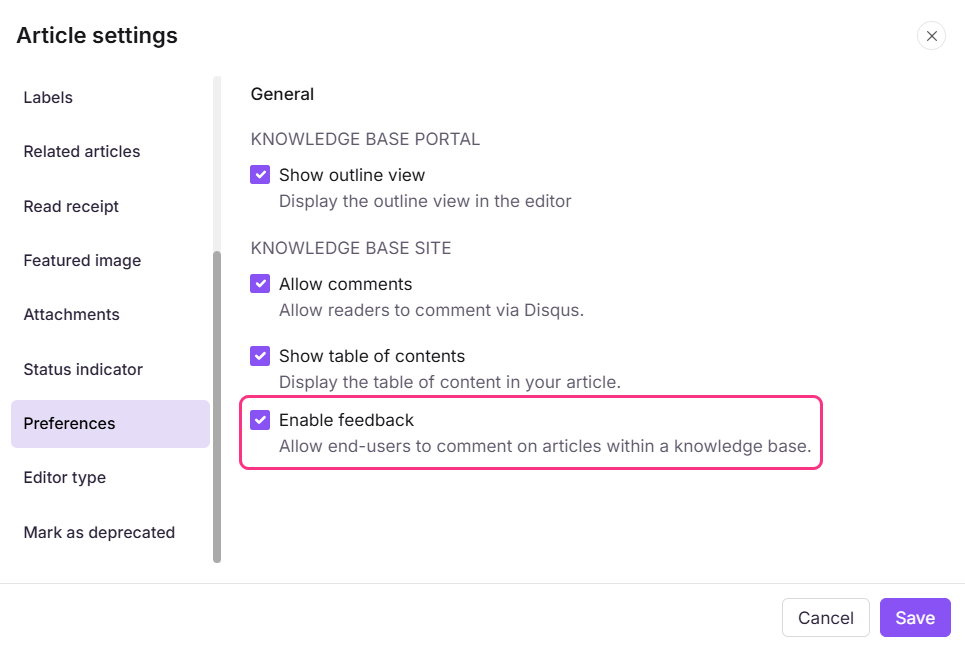
The Enable feedback option shows a "Was this article helpful?" Yes/No widget at the bottom of the article on the knowledge base site. When a reader clicks Yes or No, a Leave a feedback dialog opens for them to submit written feedback.
- Navigate to the article in the knowledge base portal.
- Click the More () icon in the article header and select More article options.
- In the Article settings panel, select the Preferences tab.
- Select the Enable feedback checkbox to enable it, or clear it to disable it.
- Click Save.
Reader feedback responses can be reviewed in Analytics (). Use this data to identify articles that may need improvement.
.png)
Best practices
- Keep the table of contents enabled for long articles. Disable it only for short articles with fewer than three headings, where it adds visual clutter without navigation value.
- Enable feedback on high-traffic articles. Turn on Enable feedback for onboarding guides or troubleshooting pages and review responses regularly in Analytics.
- Establish a comment moderation process before enabling Disqus. If you enable Allow comments, ensure your team has a process for responding to reader comments before making it live.
- Use per-article preferences for exceptions, not the rule. For consistent behavior across all articles, configure defaults under Settings () > Knowledge base site > Article settings. Use per-article preferences only when a specific article needs different behavior.
FAQ
What is the difference between Allow comments and Enable feedback?
Allow comments enables a Disqus-powered public comment thread on the article, requiring the Disqus integration to be configured. Enable feedback shows the "Was this article helpful?" Yes/No widget at the bottom of the article, which opens a Leave a feedback dialog when clicked. Both can be enabled or disabled independently per article.
Do preference changes apply immediately to published articles?
Yes. Preference changes such as showing or hiding the table of contents or enabling feedback take effect immediately on the knowledge base site without needing to republish the article.
Can I show or hide the table of contents for the entire knowledge base at once?
Yes. Navigate to Settings () > Knowledge base site > Article settings and toggle Show table of contents under the Article right section. This applies site-wide to all articles.
Will removing the Disqus integration turn off public comments on all articles?
Yes. Removing the Disqus integration turns off commenting entirely across all articles. If you re-enable Disqus later, you will need to reconfigure the integration.
Does bold text used as headings appear in the table of contents?
No. Only headings formatted as H2, H3, and H4 appear in the table of contents. Bold text that is not a heading will not appear.